

Let me be honest with you about something.
Most comparison articles between EPM platforms are written by people who have never actually sat through a 14-week OneStream implementation or spent three days debugging an SAP BPC transformation logic error at midnight before a board presentation.
This one is different. We’ve been implementing EPM platforms for over a decade. We’ve worked inside OneStream, SAP BPC, Anaplan, and Hyperion, and we cover that full lineup separately in OneStream vs. Hyperion vs. Anaplan: CPM Platform Comparison. We’ve also had the uncomfortable conversations with CFOs who picked the wrong platform and are now three years into a system they don’t love.
So this guide isn’t a feature checklist. It’s the conversation we’d have with you over coffee if you were genuinely trying to figure out which platform is right for your finance team in 2026.
Let’s get into it.
QUICK ANSWER
If you need one connected platform for close, consolidation, and planning, OneStream XF is typically the strongest fit for mid-market and enterprise finance teams — implementations average 10-16 weeks and $180K-$400K. SAP BPC makes sense mainly if you’re deeply embedded in the SAP ecosystem already. Anaplan wins when connected planning across sales, workforce, and supply chain matters more than statutory consolidation, but it usually needs a separate close tool.
Table of Contents
Why Your EPM Platform Choice Matters More Than Ever in 2026
Here’s a number worth sitting with: according to Gartner, 74% of CFOs say financial reporting and planning still isn’t fast enough to support the decisions their business needs to make. That’s not a data problem. In most cases, it’s a platform problem.
The finance function has changed enormously in the past five years. Boards want real-time visibility. Investors expect scenario modeling to happen in hours, not weeks. And finance teams stuck on legacy CPM tools are increasingly the bottleneck in their own organizations.
SAP BPC was genuinely excellent when it was built. Anaplan redefined what connected planning could look like. And OneStream entered the market with a bold claim: one platform to handle close, consolidation, reporting, and planning without bolt-ons or integrations between modules.
The question isn’t which of these is the ‘best.’ It’s which one is right for your situation. That’s what we’re going to help you figure out.
The Three EPM Platforms Compared: OneStream, SAP BPC, and Anaplan
OneStream XF
OneStream was founded in 2010 by former Hyperion executives who believed the CPM market needed a complete rebuild, not an upgrade. Their core idea, ‘one platform, one model,’ means no separate modules for consolidation, planning, and reporting — it’s all connected inside a single unified system.
For finance teams that have spent years fighting integration issues between their close tool, their planning tool, and their reporting tool, that pitch lands well. And in our experience, it largely delivers on it.
OneStream is particularly strong for companies that need statutory consolidation and financial close as their primary use case, with deep capabilities in multi-entity, multi-currency consolidation, intercompany elimination, and audit trails. We go deeper on why the single-platform model matters in The Benefits of OneStream’s Unified CPM Platform. If your auditors are currently sending you stress-inducing email threads every quarter, OneStream will make those significantly shorter.
One platform for close, consolidation, planning, and reporting. No integrations between modules. That’s OneStream’s founding promise, and after 50+ implementations, we think it largely keeps it.
— TriState Technology Implementation Team
SAP Business Planning and Consolidation (BPC)
SAP BPC is the veteran in the room. It’s been around since 2007 (originally as Outlooksoft, then acquired by SAP), and if you’re running a large enterprise with SAP ERP at its core, it has one obvious advantage: native integration with your existing SAP ecosystem.
The reality is more nuanced, though. SAP BPC has two flavours: BPC for SAP BW (now largely replaced by SAP Analytics Cloud, or SAC) and BPC Embedded for SAP S/4HANA. Depending on which version you’re on and which version of SAP ERP you run, your implementation experience can vary significantly.
Where SAP BPC gets difficult is administration. Changes to financial models often require IT involvement. Implementations routinely take 20-36 weeks. And if you’re on an older version, migrating to SAC is effectively a re-implementation anyway.
Our honest take: if you’re deeply embedded in SAP and your primary use case is consolidation within that ecosystem, BPC or SAC can work well. If you’re evaluating fresh without a legacy SAP dependency, it’s rarely the most compelling choice on its own merits in 2026.
Anaplan
Anaplan is the connected planning specialist. It’s genuinely excellent at what it was designed for: building complex, interconnected planning models that span multiple business functions. Sales planning, workforce planning, supply chain, and financial planning can all live on the same platform and talk to each other in real time.
If you’ve ever tried to reconcile a sales forecast from a spreadsheet with a finance model in one tool and a headcount plan in another, you understand the problem Anaplan solves. It solves it well.
Where Anaplan is weaker is statutory consolidation and financial close. It isn’t built to be a consolidation engine, so companies that use it for close typically need a separate tool for that. It’s also the most expensive of the three in licensing at scale, and its ‘hyper-connected cells’ data model has a steeper learning curve than it appears in demos.
The best Anaplan deployments we’ve seen are at companies where planning complexity, not close complexity, is the primary pain point.
OneStream vs. SAP BPC vs. Anaplan: The Honest Feature Comparison
We put together a simplified comparison across the dimensions that actually matter in most platform evaluations. This is based on our own project experience, not vendor-provided data sheets.
| Feature | OneStream XF | SAP BPC | Anaplan |
| Consolidation | Native, unified | Strong (BW-dependent) | Needs bolt-on |
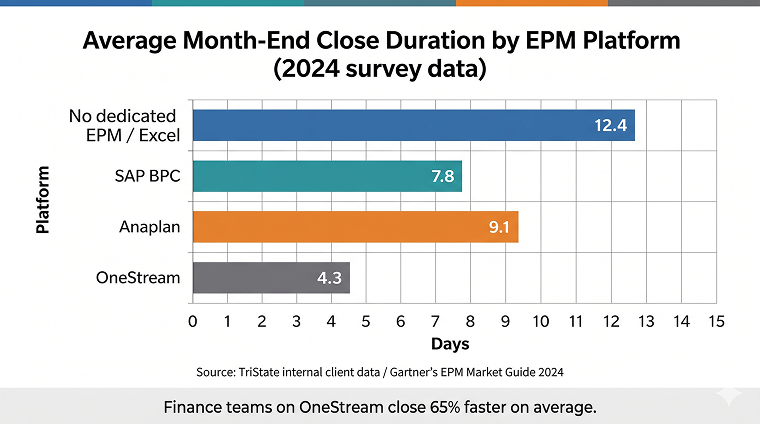
| Financial close speed | 4-6 days avg | 8-12 days avg. | Not primary use |
| Planning & forecasting | Built-in, driver-based | Rigid, IT-heavy | Excellent, flexible |
| Implementation time | 10-16 weeks | 20-36 weeks | 16-28 weeks |
| Typical implementation cost | $180K – $400K | $400K – $1M+ | $300K – $800K |
| Annual license (mid-market) | $80K – $200K | $150K – $500K | $120K – $350K |
| Admin dependency on IT | Low | High | Medium |
| Audit trail | Automated, native | Manual/semi-auto | Limited native |
| AI/ML built-in | Yes (Signals) | Limited | Yes (PlanIQ) |
| Best fit | Finance-led EPM | Large SAP ecosystems | Connected planning |
Note: Implementation costs and timelines vary significantly based on scope, data quality, and client readiness. These are typical ranges from our project history, not guarantees.
What Actually Determines EPM Implementation Success (Beyond the Platform)
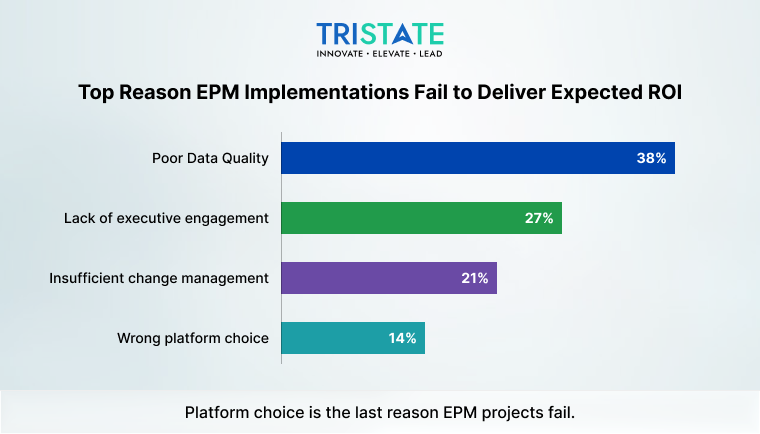
We’ve seen every major platform succeed. And we’ve seen every major platform fail. After 50+ EPM implementations, we can tell you with reasonable confidence: the platform is rarely the reason a project goes wrong.
Here’s what actually determines whether your EPM implementation delivers the results you’re expecting:
1. The State of Your Data Before You Start
This is the one we see trip up more implementations than anything else. A finance team that’s been running on legacy tools for ten years has typically accumulated a chart of accounts no one fully understands, intercompany relationships documented in someone’s head, and historical data with inconsistencies baked in at every level.
If you go into an implementation without cleaning this up first, you’re not doing an EPM project — you’re doing a data archaeology project wrapped inside an EPM project. It takes twice as long and costs twice as much.
Our rule of thumb: budget at least 3-4 weeks purely for data readiness before platform configuration starts. If you want a structured way to score where your organization stands before you commit to a timeline, our AI Readiness Framework is a useful starting point — it flags exactly where automation and AI-driven close tools like OneStream Signals will help most, and where legacy data gaps will slow you down. It feels slow up front. It pays back every week of the implementation that follows.
2. Executive Sponsorship That Runs Deeper Than the CFO
Every EPM project has CFO sponsorship on paper. The ones that go smoothly have a CFO who’s actively involved in decisions, not just signed off in month one and checking in again at go-live.
EPM implementations hit decision points constantly: which version of the truth do we use for intercompany transactions? Which entities get consolidated vs. excluded? How do we handle partial-year acquisitions? These decisions have political dimensions as well as technical ones, and they need an executive who can make the call and move on.
3. A Change Management Plan That Isn’t an Afterthought
Finance teams are creatures of habit. Many have spent years building and maintaining spreadsheet models that are effectively their job security. A new EPM platform threatens that, even if no one says it out loud.
The best implementations we’ve been part of had a dedicated person — not a consultant, a client-side person — responsible for how the finance team experienced the transition. Training mattered. Communication about what was changing and why mattered. Pilot users who became internal champions mattered.If your implementation plan has training scheduled in the last two weeks before go-live, treat that as a warning sign.
What a Realistic OneStream Implementation Roadmap Looks Like
One of the most common surprises for finance leaders going through their first EPM migration is how different the reality is from the vendor’s sales timeline. We break this down phase-by-phase in our full OneStream XF Implementation Roadmap — here’s the honest summary of what each phase actually involves:
| Phase | What happens | Typical duration | Biggest risk |
| Phase 0 — Business Case | Stakeholder alignment, current-state audit, success metrics defined | 2-3 weeks | Lack of CFO sponsorship beyond finance |
| Phase 1 — Data Readiness | Chart of accounts cleanup, data quality audit, ETL mapping | 3-5 weeks | Hidden inconsistencies in historical data |
| Phase 2 — Platform Setup | Metadata design, entity structure, security model | 2-3 weeks | Over-engineering the first version |
| Phase 3 — Build & Configure | Calculation rules, consolidation logic, reporting layer | 4-6 weeks | Scope creep from stakeholder wish lists |
| Phase 4 — Training & UAT | User acceptance testing, finance team training, bug fixes | 2-3 weeks | Finance team availability during month-end |
| Phase 5 — Parallel Run | Running old and new systems simultaneously to validate | 2-3 weeks | Teams defaulting to old system out of habit |
| Phase 6 — Go-Live | Cutover, hypercare support, first close on new platform | 1-2 weeks | First live close pressure on the team |
Total calendar time for a well-scoped OneStream implementation at a mid-market company typically runs 14-18 weeks. Implementations that rush past data readiness and stakeholder alignment in the early phases almost always recover those weeks later, at higher cost and higher stress.
So, Which EPM Platform Should You Choose?
We’ve tried to make this as useful as possible by giving you a situational decision guide rather than a blanket recommendation. The honest answer is: it depends on your specific situation. But this framework should get you most of the way there:
| Your situation | Recommended platform |
| You’re running SAP ERP (S/4HANA or ECC) and want tight integration | SAP BPC or SAC |
| You want one platform for close, consolidation, planning, and reporting | OneStream XF |
| Your primary need is connected planning across business units | Anaplan |
| You’re a mid-market company with a 10-15 week implementation budget | OneStream XF |
| You need statutory consolidation for multi-entity, multi-currency groups | OneStream XF |
| Your team wants flexibility to build complex planning models without IT | Anaplan |
| You want to migrate off legacy Hyperion or Cognos | OneStream XF |
| Cost is the #1 constraint and your needs are relatively simple | Evaluate OneStream or SAC |
If you’re genuinely torn between two options, the tiebreaker we always come back to is this: which platform will your finance team actually use three years from now? The best EPM is the one your team adopts, not the one with the most impressive demo.
Where TriState Technology Fits In
We work as an implementation partner across all three platforms, but we’ve built our deepest practice around OneStream through our dedicated OneStream development services. Over the past several years we’ve delivered OneStream projects for manufacturing groups, PE-backed portfolios, financial services firms, and healthcare organisations across India, the Middle East, and Southeast Asia.
The reason we lean toward OneStream for most of our mid-market and enterprise clients isn’t brand loyalty. It’s because the ‘unified platform’ architecture genuinely reduces the integration overhead that causes so many EPM projects to run long and over budget.
If you want an implementation partner who will tell you honestly whether OneStream (or another platform) is the right choice for your situation before you sign anything, that’s exactly the kind of conversation we like to have.
We have walked away from EPM opportunities where the platform wasn’t the right fit. Our goal is your finance team working better, not another logo on our website.
— TriState Technology Founders
The Bottom Line
There is no universally ‘best’ EPM platform in 2026. There’s only the right platform for your specific situation: your data, your team, your IT ecosystem, and the finance outcomes you need to deliver.
What we’d encourage you to do before you evaluate any platform:
- Audit your chart of accounts and data quality honestly. Know what you’re starting with.
- Define success in business outcomes first — not ‘implement OneStream’ but ‘close in under 5 days with no manual interventions.’
- Talk to someone who has done it at a company similar to yours in size and industry, not just the vendor’s reference customers.
- Get a realistic implementation timeline. If a vendor is promising you 6 weeks, ask to speak to a client who went live in 6 weeks.
If any of that sounds like a conversation worth having, we’re happy to be the first call. No pressure, no pitch deck in the first meeting — just an honest conversation about what your finance team actually needs.
Get your free OneStream Readiness Assessment. We’ll map your current state, identify the gaps, and tell you honestly whether OneStream is the right fit — and if so, roughly what it would take to get there.
BOOK YOUR FREE ASSESSMENT
Frequently Asked Questions
-
How long does an OneStream implementation take?
A well-scoped OneStream implementation at a mid-market company typically takes 10-16 weeks, with total calendar time (including data readiness and parallel run) running 14-18 weeks. Timelines stretch when data cleanup or executive decision-making is rushed in the early phases.
-
What does OneStream cost compare to SAP BPC and Anaplan?
Typical implementation costs run $180K-$400K for OneStream, $400K-$1M+ for SAP BPC, and $300K-$800K for Anaplan, based on TriState’s project history across 50+ implementations. Annual licensing for mid-market deployments follows a similar pattern: OneStream tends to be the least expensive of the three, SAP BPC the most.
-
Is Anaplan good for financial consolidation?
Not on its own. Anaplan is built for connected planning, not statutory consolidation, so companies using it for financial close typically pair it with a separate consolidation tool. If consolidation is your primary use case, OneStream XF or SAP BPC are generally the stronger fit.
-
Is OneStream better than SAP BPC?
It depends on your ecosystem. If you’re deeply embedded in SAP with S/4HANA or ECC and want tight native integration, SAP BPC or SAC can work well. If you want one unified platform for close, consolidation, planning, and reporting without a legacy SAP dependency, OneStream is typically the stronger and faster-to-implement choice.


