

Ask any FP&A team how they build a forecast and you’ll hear some version of the same story. An analyst pulls last year’s numbers into a spreadsheet, eyeballs the trend, adds a percentage for growth, tweaks a few cells because “sales always sandbags Q3,” and sends it up the chain. Two weeks later, the market moves and the whole thing is stale.
It works. Sort of. But it’s slow, it leans on gut feel, and when the business asks “why is this number what it is?” the honest answer is usually “because that’s what we always do.”
There’s a better way sitting right inside OneStream, and you don’t need to hire a single data scientist to use it. It’s called Sensible ML and this post walks through what it is, how it works, and why finance teams are quietly making it their forecasting engine.
Quick note on the name:
OneStream rebranded Sensible ML to SensibleAI Forecast at its Splash 2026 conference, folding it into a wider SensibleAI portfolio. Same proven machine-learning engine under the hood now with added generative-AI features for scenario modeling and plain-English commentary. You’ll still hear people call it “Sensible ML,” so we use both names here.
Table of Contents
What is OneStream Sensible ML?
Sensible ML is OneStream’s built-in machine-learning forecasting solution. In plain terms: it looks at your historical data, learns the patterns, and produces a forecast automatically.
What makes it different from bolting a data-science tool onto your finance stack is that it lives inside OneStream. No exporting data to a separate platform. No handing spreadsheets to a modeling team and waiting a month. No black box you can’t explain to the CFO. The forecast is generated where your plans, budgets, and actuals already live.
It was OneStream’s first AI-enabled Market Place solution, and the whole point was to take something that used to require a PhD and a big budget machine-learning forecasting and make it usable by the people who actually own the numbers.
Sensible ML vs. Sensible AI Forecast: the 2026 rebrand, explained
If you’re researching this today, you’ll trip over two names, so let’s clear it up.
Sensible ML was the original machine-learning forecasting engine. At Splash 2026, OneStream renamed it SensibleAI Forecast and gave it new generative-AI abilities on top of the same ML core.
The upgrade added two things finance folks actually asked for: the ability to model different scenarios and constraints quickly, and automatic narrative commentary that explains the story behind a forecast in normal English.
So, if you inherited a project that says “Sensible ML” or read an older guide, it’s the same lineage. The forecasting engine you’re evaluating is now Sensible AI Forecast. Everything in this article applies to both.
How Sensible ML works (without anyone writing code)
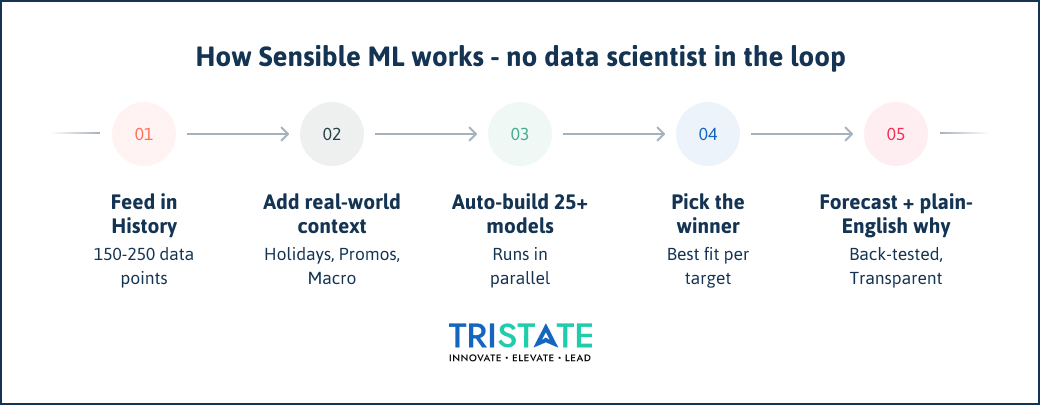
Here’s the part that usually surprises people. The heavy lifting is automated end to end. Walk through it:
1. You feed it history
Sensible ML typically wants around 150–250 historical data points to learn from think a couple of years of monthly figures, or more if you’re forecasting weekly or daily demand.
2. It adds real-world context
On its own, the tool can pull in outside signals like macro-economic data. And through its “event builder,” you can layer in the things you know matter holidays, promotions, a big product launch, a plant shutdown. This is where your business knowledge goes in, no coding needed.
3. It builds and tests dozens of models at once
This is the engine room. Sensible ML runs more than 25 algorithms in parallel ARIMA, SARIMA, and many others automatically generating features and figuring out which variables actually drive your numbers. A data scientist would do this by hand over weeks. The tool does it in the background.
4. It picks the winner
Instead of you choosing a model and hoping, Sensible ML compares them all and surfaces the best-performing model for each thing you’re forecasting. Forecasting 500 products? It can find the right model for each one.
5. It hands you a forecast you can explain
You get the numbers plus transparency. “Feature transparency” dashboards show which drivers moved the forecast and by how much. And you can back-test see how the model would have performed against history before you trust it. No black box.
That’s the whole loop. Notice what’s missing: a data scientist, a separate ML platform, and a month of waiting.
Why you don’t need a data science team
This is the objection I hear most: “AI forecasting sounds great, but we don’t have the people for it.”
That’s exactly the barrier Sensible ML was built to remove. OneStream says it plainly using Sensible ML does not require in-house data scientists or anyone who understands machine learning. The feature engineering, model selection, and retraining that normally demand specialist skills all happen under the hood.
Think about what a traditional ML forecasting project usually costs you: hiring or contracting data scientists, standing up a separate tool, building data pipelines, and then keeping it all running. For most mid-market finance teams, that math never works so they stick with spreadsheets.
Sensible ML changes the equation. The people who already understand the business your FP&A analysts, your demand planners run it themselves. Their business intuition becomes the input, not a bottleneck.
The results finance teams actually see
Numbers matter more than promises, so here’s what OneStream reports across its customer base using SensibleAI Forecast:
- Forecast accuracy up ~25% on average. Better inputs mean fewer nasty surprises and less scrambling to re-plan.
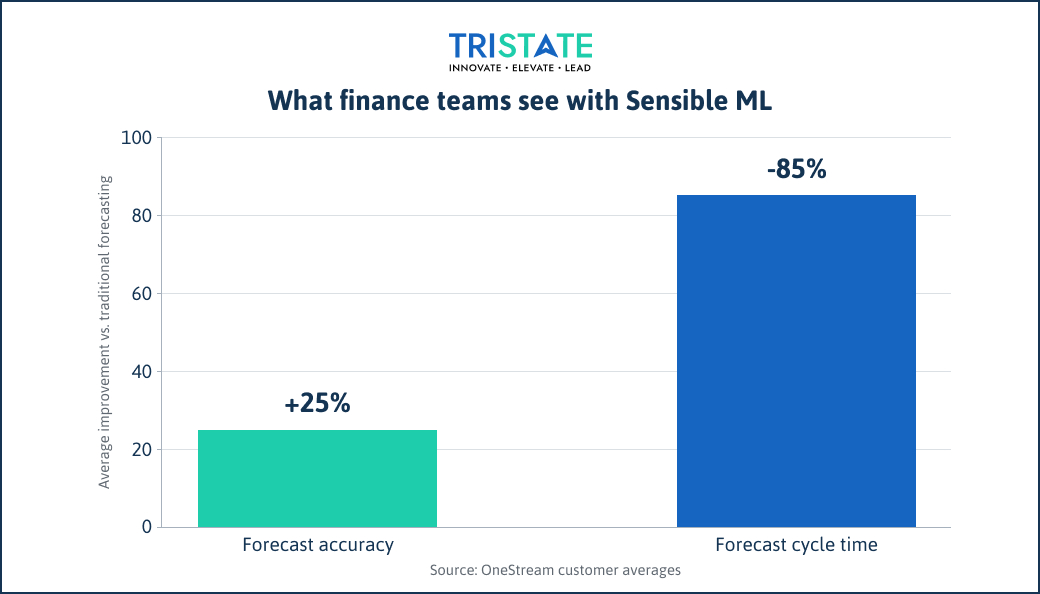
- Forecast cycle times down ~85% on average. By automating data prep, model selection, and prediction, the work that took a team a week or two can run in a fraction of the time.
A 25% accuracy gain isn’t just a nicer number it’s fewer stockouts, less trapped working capital, and a forecast leadership can actually plan against.
There’s a softer benefit too, and finance leaders feel it: the end of reforecasting fatigue. When re-running a forecast is fast and mostly automated, you can do it as often as the business needs monthly, weekly, whenever the ground shifts instead of dreading it.
Where Sensible ML fits best
It isn’t magic for every number on the P&L. It shines on time-series forecasting where you have history to learn from. The strongest use cases:
- Demand planning Daily, weekly, or monthly product-level demand
- Sales & Operations Planning (S&OP) aligning supply and demand with a forecast everyone trusts
- Revenue and FP&A forecasting replacing “last year plus 5%” with something defensible
- High-volume, granular forecasts hundreds or thousands of SKUs, stores, or accounts, each with its own best-fit model
If you’re forecasting a handful of line items once a year, a spreadsheet is fine. If you’re forecasting at volume, on a tight cycle, and getting asked to justify every number that’s Sensible ML’s sweet spot.
Sensible ML vs. traditional forecasting, side by side
| Forecasting Aspect | Traditional / Spreadsheet | OneStream Sensible ML |
| Who runs it | Analysts, manually | Same analysts, automated |
| Model building | Gut feel or one basic method | 25+ models tested automatically |
| Time to a forecast | Days to weeks | Hours ~85% faster on average |
| Accuracy | Depends on the analyst | ~25% higher on average |
| Can you explain it? | “That’s how we do it” | Transparency dashboards + back-testing |
| Data scientists needed | N/A | None |
| Where it lives | Separate spreadsheets | Inside OneStream, next to your plans |
Getting started
You don’t have to boil the ocean. Most teams start with one painful forecast the SKU-level demand plan, the rolling revenue forecast prove the accuracy gain, and expand from there.
A few things that make the first project go smoothly:
- Pick a use case with clean history. You’ll want roughly 150–250 data points. Demand and revenue series usually qualify.
- Gather your “known events.” Holidays, promotions, launches the context only your team knows. That’s what sharpens the model.
- Back-test before you trust it. Run the model against last year and see how it would have done. It builds confidence fast.
- Get a partner who knows OneStream. The tool removes the data-science barrier, but a smooth setup data integration, Marketplace configuration, training your team still benefits from experienced hands.
The bottom line
For years, machine-learning forecasting was something only big companies with data-science teams could afford. Sensible ML flips that. It puts genuinely advanced forecasting 25+ models, automatic tuning, full transparency into the hands of the finance and operations people who already own the numbers, right inside OneStream. No data scientists. No separate platform. No black box.If your team is still forecasting the old way and quietly dreading the next cycle, this is the upgrade worth a serious look.
At TriState Technology, we help finance teams implement OneStream and get real value from Sensible ML / SensibleAI Forecast from data integration to go-live to training your team.

Frequently Asked Questions
-
Is Sensible ML the same as SensibleAI Forecast?
Yes. SensibleAI Forecast is the current name for the solution formerly called Sensible ML, rebranded by OneStream in 2026 with added generative-AI features.
-
Do we need data scientists to use OneStream Sensible ML?
No. It’s designed for finance and operations teams. The model building, tuning, and retraining are automated.
-
How much historical data does Sensible ML need?
Typically around 150–250 historical data points for example, a couple of years of monthly figures, or more for weekly/daily forecasts.
-
What can Sensible ML forecast?
Time-series use cases like demand planning, S&OP, and revenue/FP&A forecasting, including high-volume, granular forecasts across many products or accounts.
-
How much does it improve forecasting?
OneStream reports average gains of roughly 25% in forecast accuracy and around 85% reduction in forecast cycle time across its customers.


