

Developers now turn to tools like ChatGPT and Claude almost without thinking twice. They use them to track down bugs, make sense of unfamiliar code, write tests, or get through work that would otherwise take hours. That’s useful for software teams, especially when project deadlines are tight. It also raises a question that deserves more attention.
What happens when the code pasted into one of these tools belongs to the company or, more importantly, to a client?
Picture a team maintaining an application it has built over several years. Buried inside it are pricing formulas, integrations and business rules that took considerable effort to get right. One developer copies a troublesome function into an AI chat to find a bug. The answer helps. But nobody checked whether that function was allowed to leave the project environment.
That’s the real issue. The team shouldn’t have to give up the advantages of AI. It should know where the boundaries are before sharing anything sensitive.
Table of Contents
Key Takeaways
- AI tools can save developers time, provided everyone knows what company or client code is off limits.
- The business versions of ChatGPT and Claude have different data protections from many consumer offerings. Read the terms for the product you’re actually using.
- A promise not to train on your data doesn’t mean the data never leaves your network or is never retained.
- When code cannot be sent outside, a properly secured model running in a company-controlled environment may be an option.
- You usually don’t need to build a new model. An existing open-weight model connected to approved internal knowledge may do the job.
- For many teams, a mix of approved commercial tools and private AI is more realistic than choosing only one.
Why Enterprises Must Protect Proprietary Source Code
The source code behind a software product is not just a set of programming files. It often holds years of decisions: why an approval works a certain way, how prices are calculated, or how a complex integration handles unusual cases. Some of those decisions are exactly what makes the product valuable.
Take a fintech product that calculates lending risk using its own rules. An engineer might want an AI assistant to improve a slow function. There’s nothing unusual about that request. The difficulty begins if the engineer shares the full calculation logic through a service the company has never approved.
The same situation can come up in a hospital application, a manufacturing ERP, or a logistics platform. The code may reveal far more about the business than the developer intended.
For IT service companies, the responsibility is even wider. Access to a client’s Git repository does not automatically give a developer permission to upload its contents somewhere else. The company needs a common policy; asking each engineer to make that call alone is not a workable safeguard.
Does ChatGPT or Claude Store or Train on Your Code?
There isn’t one answer for every ChatGPT or Claude account. OpenAI says it does not train on data from ChatGPT Business, ChatGPT Enterprise or its API by default. Anthropic describes similar default protections for its commercial products, including Claude for Work and its API. The exact product and agreement matter, so teams should check those details before using it for client work.
That is reassuring, but it answers only one part of the question. The provider still has to process a request to respond to it. Conversation history, retention periods, connected tools and other settings can differ between products. ‘Not used for training’ should never be read as ‘never sent to or stored by an external service.’
Before approving a tool, ask simple questions. Where does our code go? How long does it stay there? Can administrators control access? Are other services involved? And do our client contracts allow this kind of processing? In some cases an enterprise subscription is enough. In others, the answer will be to keep the work in a private environment.
Relevant Policies: OpenAI Enterprise Privacy and Anthropic Commercial Data Usage.
What Are the Risks of Sharing Source Code with AI?
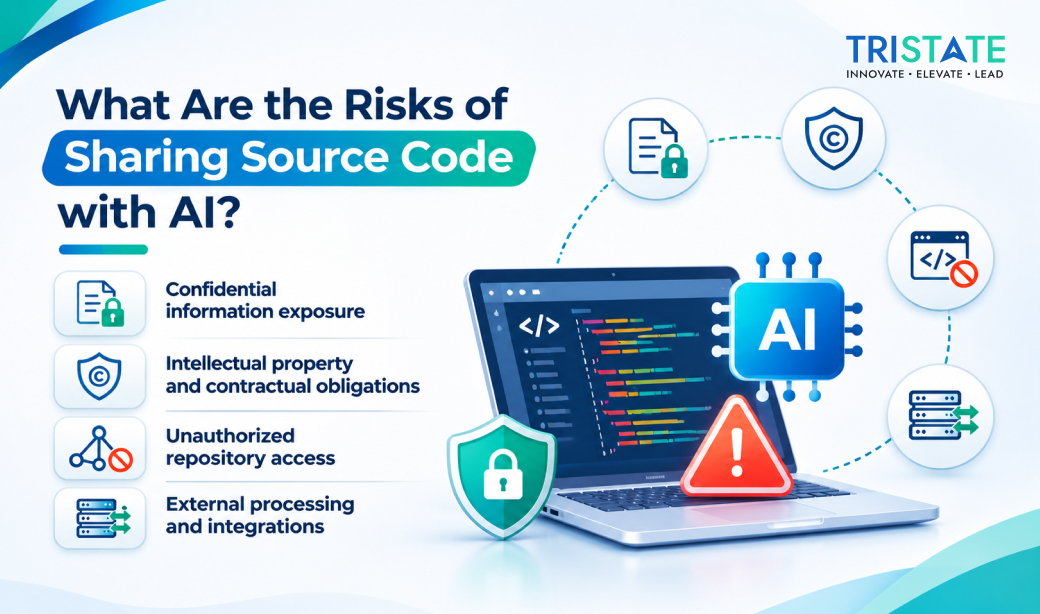
Confidential Information Exposure
A short snippet can carry more than a bug. It might include a pricing rule, a customer ID, an API key or an internal endpoint. When someone is trying to fix an urgent issue, it’s easy to paste more context than necessary.
Intellectual Property and Contractual Obligations
Uploading code to an AI service does not, by itself, hand over its copyright. Still, a company may have promised customers that their code will only be handled in certain systems. Those commitments—and any license restrictions—continue to apply when AI enters the workflow.
Unauthorized Repository Access
Some coding assistants can inspect repositories and run development tools. If an integration is given broad permissions, an employee could end up seeing files from a project they were never meant to access. AI shouldn’t quietly override the access rules already in place.
External Processing and Integrations
A request may travel through an AI provider, its infrastructure and any connected services. It helps to map those connections before enabling them, rather than discovering the data flow after a sensitive file has been shared.
How Private Enterprise AI Models Work
For code that must stay within a controlled environment, a company can run an appropriately licensed open-weight model on its own servers or dedicated cloud infrastructure. Developers then send requests to that internal system instead of a public model API.
The model can work alongside approved repositories, documents and developer tools. It might help explain an old module, point to related files or suggest test cases. If the whole setup is configured to keep processing internal, the underlying code need not be sent to an outside model provider.
Think of a manufacturer whose ERP has custom rules for production orders and inventory. Its engineers often need to find where a calculation is made and what depends on it. A private assistant could help them navigate those modules while keeping the source inside the company’s approved environment.
There is a trade-off, of course. Running the model yourself means taking responsibility for server security, credentials, network access, updates and monitoring. Private hosting gives you more control; it doesn’t remove the need for security work.
Private AI vs. Commercial Enterprise AI Platforms
| Consideration | Commercial Enterprise AI | Private / Self-Hosted AI |
| Hosting | Provider-managed | Enterprise-controlled |
| Setup | Usually faster | Requires deployment |
| Model capability | Provider’s available models | Depends on selected model |
| Data processing | External service | Can remain internal |
| Customization | Product-dependent | More deployment control |
| Maintenance | Mostly provider-managed | Enterprise or partner |
| Cost structure | Subscriptions / API usage | Infrastructure and operations |
A private setup isn’t automatically the best choice for every task. Teams might use an approved enterprise AI product to discuss general programming questions, while keeping sensitive algorithms or client-specific code in a self-hosted system. That split can be easier to maintain than forcing every developer request through the same route.
How to Build a Secure AI Coding Assistant
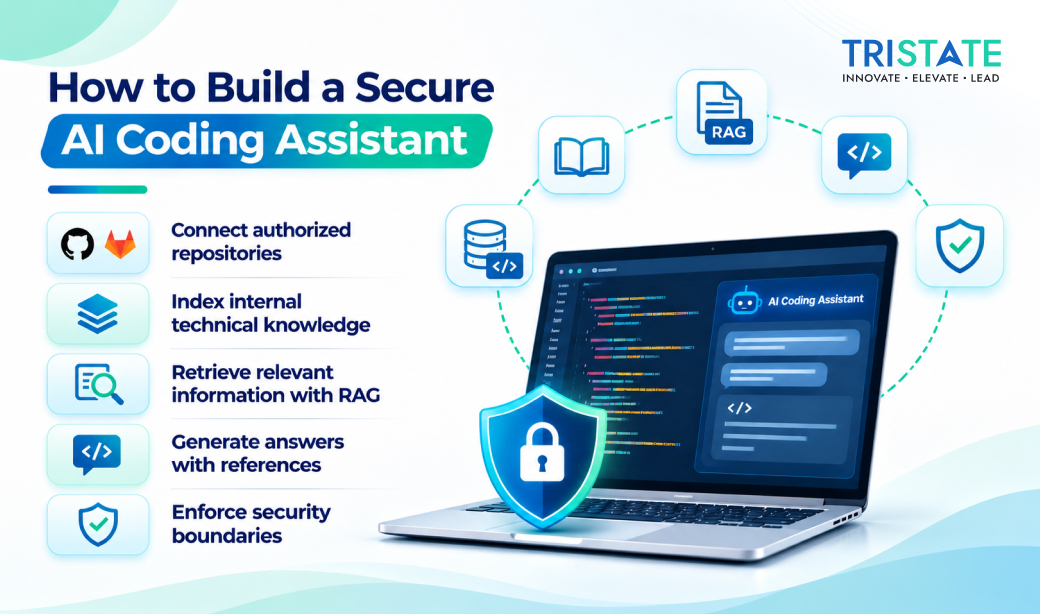
A useful internal coding assistant doesn’t need to copy an entire repository into a chat. It can find the relevant files when a developer asks a question, then use those files to prepare an answer. A practical setup looks something like this:
Connect Authorized Repositories
Connect only the GitHub, GitLab or internal repositories the assistant needs. A developer should see only the projects they already have permission to open.
Index Internal Technical Knowledge
Make approved code and documentation searchable. Remember that the index may contain sensitive code fragments too, so store and protect it accordingly.
Retrieve Relevant Information with RAG
With Retrieval-Augmented Generation (RAG), the assistant searches for relevant material when a question arrives. If someone asks, ‘Where is invoice tax calculated, and what else uses that function?’, the system can pull the related files rather than feeding the entire repository to the model.
Generate Answers with References
The response can explain the code, show where it found the information and suggest tests or changes. Those references make it easier for the developer to verify the answer. Any proposed code still needs ordinary review before it is merged.
Enforce Security Boundaries
Keep permissions, network restrictions and audit logs in place throughout the process. If the assistant serves two clients, it must not let a question about one client’s project return code from the other.
Do Enterprises Need to Train Their Own AI Models?
In most cases, no. Before spending money on training, try an existing open-weight model from a family such as Llama or Qwen, subject to its license. Connect it to relevant internal material and test it against the questions developers actually ask. Often that is enough.
Training becomes worth considering when the same problems keep showing up. A team building manufacturing software, for example, may find that the assistant regularly misunderstands its production terminology or coding conventions. With properly approved examples, fine-tuning might help. But first the team should measure how often the problem occurs and whether simpler changes fix it.
Fine-tuning brings its own workload: preparing reliable examples, running experiments and checking that one improvement hasn’t caused another problem. The resulting model files also need protection, since trained models can retain information from the data they learned on. Don’t train simply because the option exists.
Best Practices for Secure Enterprise AI Adoption
- Set out an AI usage policy people can actually follow. Name the approved tools and explain which client code or business information must stay out of them.
- Identify what deserves extra protection. Secrets, proprietary algorithms and restricted repositories should not be treated like ordinary documentation.
- Check the enterprise terms before rollout. Look beyond the headline privacy promise to retention settings, administration controls and contracts.
- Keep project permissions intact. AI search and tool integrations should follow the same access boundaries as the original systems.
- Consider private deployment where code is not permitted to leave the environment. Don’t pay for that complexity unless the requirement is real.
- Know which tools and services receive data. Review logs, integrations and permissions as the implementation changes.
- Keep human code review. An AI suggestion can be helpful and still be wrong, insecure or unsuitable for the project.
A sensible way to start is with one team and one approved repository. Give the assistant a few useful jobs—finding a function, explaining a dependency or preparing unit tests—and see how well it does. Also test what it should refuse: Can it reveal a restricted file? Does it repeat a secret? Does it confidently refer to code that doesn’t exist? A small trial will tell you far more than a broad promise about AI productivity.
The Future of Enterprise AI Is About Control
AI coding assistants are already moving beyond autocomplete. They can help developers explore unfamiliar applications, trace a bug across modules and handle some of the tedious parts of day-to-day engineering. Used well, that’s a real advantage.
But it’s worth being clear about the limits. A tool that makes developers faster should not create uncertainty about where client code has gone or who has been allowed to read it. Those are business decisions, not just technical settings.
There won’t be one architecture that fits everyone. An enterprise AI subscription may work for one team, a private model for another, and a combination for the rest. What matters is choosing deliberately, based on the code involved and the company’s obligations, rather than letting the decision happen one pasted prompt at a time.
How TriState Technology Helps Enterprises Adopt AI Securely
Adopting AI in enterprise software requires the right balance between innovation, data privacy, and security. TriState Technology helps businesses explore and implement AI solutions aligned with their technical requirements and data protection needs.
From private AI deployments and custom AI development to RAG-based knowledge assistants and LLM integration, our team helps organizations identify practical approaches to using AI within their existing software environments.
Planning a secure AI implementation for your enterprise? Contact TriState Technology to discuss your requirements and explore the right approach for your business.
Frequently Asked Questions
-
Is it safe to share proprietary source code with ChatGPT or Claude?
It can be, but first check which product the team is using and what your company has agreed to. A controlled enterprise account is different from an unapproved personal account. Client confidentiality rules still matter.
-
Does ChatGPT train on enterprise source code?
OpenAI says ChatGPT Business, ChatGPT Enterprise and API data are not used for training by default. That doesn’t mean requests are never processed or retained, so check the relevant settings and terms.
-
Can AI process code without sending it to external servers?
Yes. A self-hosted model can handle approved code internally, provided the application, search index, logging and network connections are configured to keep that data inside.
-
Is private AI the same as ChatGPT Enterprise?
No. ChatGPT Enterprise is operated by OpenAI. A private AI setup generally runs in infrastructure the organization controls or has approved for that purpose.
-
Must enterprises build their own AI models?
Usually not. Many teams can get useful results from an existing open-weight model and a secure way to retrieve internal information. Test that approach before considering training.
-
What does RAG do?
RAG searches approved documents or code when someone asks a question, then supplies the relevant pieces to the model. It means the model can work with current information without first being trained on the whole repository.
-
Is self-hosted AI automatically secure?
No. You still have to secure the servers, restrict access, watch integrations and keep the environment updated. Hosting the model privately is only one part of the job.
Also read: AI Agents & Agentic Automation for Business.


