

Most companies have already experimented with generative AI.
Employees use it to write emails, summarise documents, prepare reports and search for information. These tools have saved time, but in many cases, the user still has to guide every step.
That is now changing.
In 2026, enterprises are moving from AI that only answers questions to AI that can take action. Enterprise AI agents can understand a request, decide what needs to happen, connect with business systems and complete a multi-step workflow.
For example, an AI assistant may tell a customer that an invoice is overdue. An AI agent can check the invoice, review the customer’s payment history, prepare a follow-up message, update the CRM and create a task for the account manager.
This shift from assistance to action is why agentic AI in enterprises has become an important business topic.
However, the story is not simply that every company is deploying autonomous AI agents everywhere. Adoption is growing quickly, but many organizations are still learning where agents work well, where human approval is necessary and how business value should be measured.
McKinsey’s 2025 global survey found that 88% of respondents said their organisation regularly used AI in at least one business function. However, only 23% said their organisation was scaling an agentic AI system, while another 39% were still experimenting with AI agents.
That gap between experimentation and scale explains much of what is happening in 2026.
Table of Contents
What Are Enterprise AI Agents?
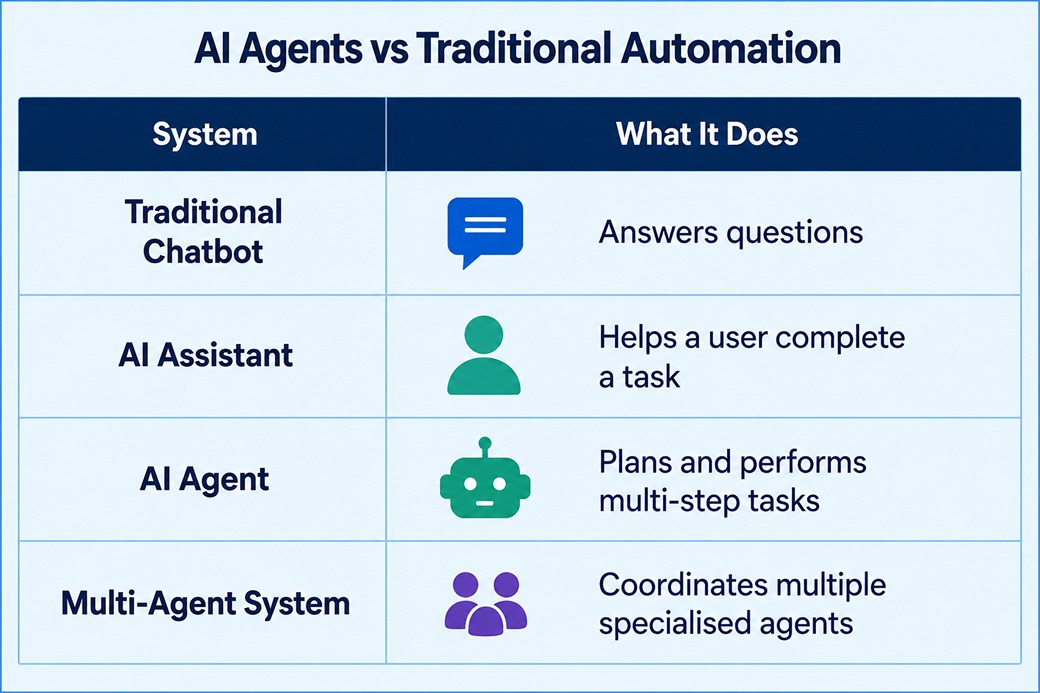
Enterprise AI agents are software systems that use AI to complete business tasks on behalf of users or teams.
Unlike a basic chatbot, an AI agent does not only generate a response. Depending on its permissions, it may also:
- Understand the user’s goal
- Break the goal into smaller tasks
- Retrieve information from approved systems
- Decide which tool or workflow to use
- Perform actions through APIs
- Check the result
- Ask for human approval when required
- Record what it has done
A chatbot may answer:
“The customer’s subscription expires next week.”
An AI agent may:
- Find all subscriptions expiring next week.
- Check whether renewal emails were sent.
- Prepare personalized reminders.
- Send approved messages.
- Update each opportunity in the CRM.
- Alert the sales manager about high-value accounts.
This ability to plan and act is what separates enterprise agentic AI from traditional generative AI.
Why Enterprise AI Agents Matter in 2026
The interest in AI agents is not based only on technical excitement. Companies are under pressure to improve productivity, reduce operational delays and offer faster service without continuously increasing headcount.
PwC surveyed 300 senior executives in 2025 and found that 79% said AI agents were already being adopted in their companies. Among organisations adopting them, 66% reported measurable value through improved productivity. In the same survey, 88% expected their AI-related budgets to increase because of agentic AI.
These numbers show strong confidence, but they need to be read carefully.
Many companies count agent features inside existing enterprise software as adoption. That does not always mean they have completely redesigned their workflows around autonomous AI agents.
The bigger opportunity comes when organisations move beyond isolated tools and use agents to coordinate actual business processes.
Why Enterprise Investment in AI Agents Is Increasing
| Enterprise AI indicator | Percentage |
| Executives reporting AI agent adoption | 79% |
| Adopters reporting measurable productivity value | 66% |
| Executives planning higher AI budgets | 88% |
How Enterprises Use AI Agents in 2026
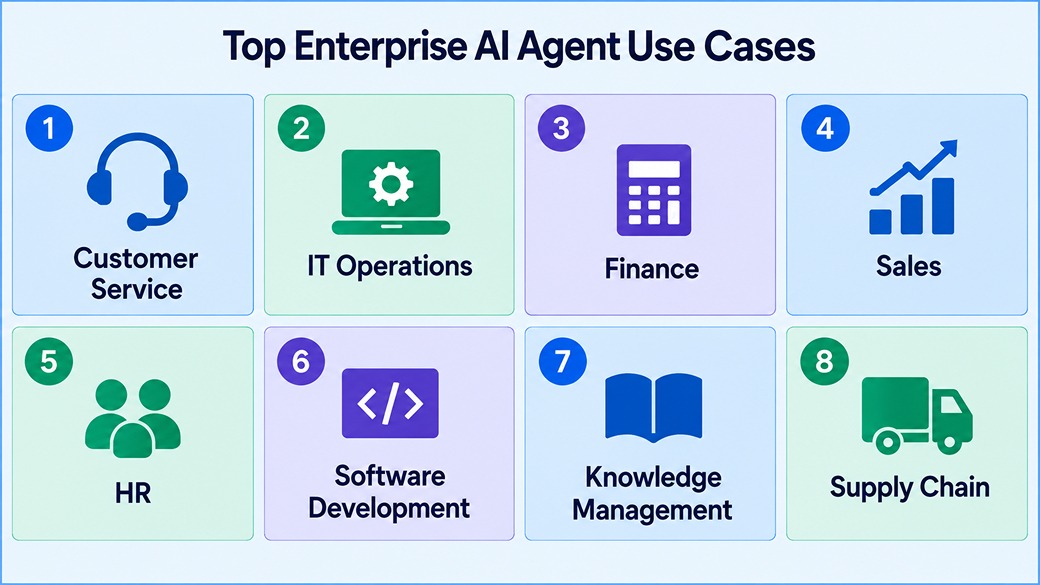
The most effective AI agent usecases are not usually the most futuristic ones. They are often repetitive workflows that involve several systems, clear business rules and frequent manual follow-ups.
Here are some of the areas where enterprises are seeing practical value.
1. Customer Service Agents That Resolve, Not Just Respond
Customer service was one of the earliest areas to adopt conversational AI. Traditional bots could answer common questions but often failed when a request required access to an account, a policy decision or an action in another system.
Modern customer service agents can go further.
They may:
- Identify the customer and retrieve account information
- Understand the issue from previous conversations
- Check an order, payment or subscription
- Create a replacement or refund request
- Reschedule an appointment
- Update the support ticket
- Escalate sensitive cases to a human agent
- Prepare a complete summary before escalation
The value is not simply fewer customer service employees. A more useful outcome is reducing the time employees spend switching between systems and repeating the same administrative steps.
For organisationsimplementing AI agents for business, customer service is often a good starting point because ticket volumes, response times, resolution rates and customer satisfaction can all be measured.
Metrics to track
- First-response time
- Average resolution time
- First-contact resolution
- Escalation rate
- Cost per ticket
- Customer satisfaction score
- Percentage of actions corrected by employees
2. IT Support and Operations
IT teams receive a large number of predictable requests:
- Password resets
- Software-access requests
- Device issues
- Account provisioning
- Service outages
- Permission changes
- Repeated troubleshooting questions
An enterprise AI agent can collect the required information, check internal policies and initiate an approved workflow.
For example, when an employee requests access to a reporting platform, the agent could:
- Confirm the employee’s role.
- Check the company’s access policy.
- Identify the correct approval manager.
- Create the access request.
- Notify the employee about its status.
- Update the IT service-management system.
McKinsey found that IT and knowledge management were among the business functions where agent use was most commonly reported.
Companies are also using agents to review logs, group related incidents, recommend possible causes and prepare incident reports. High-impact actions, such as restarting production services or changing permissions, normally remain behind human approval.
This is a practical example of human-in-the-loop AI: the agent prepares the work, but an authorised person controls the final decision.
3. Finance and Accounting Workflows
Finance teams work with structured processes, policies, documents and approval rules. This makes finance suitable for carefully controlled enterprise AI automation.
Common use cases include:
- Invoice validation
- Expense-policy checks
- Payment follow-ups
- Account reconciliation support
- Cash-flow commentary
- Variance analysis
- Financial-data collection
- Management-report preparation
- Purchase-order matching
- Month-end close coordination
Consider an accounts-receivable agent.
Instead of only generating a reminder email, it could review overdue invoices, classify customers by risk, check previous communication, prepare a suitable message and update the finance system after approval.
Another agent may support the month-end close by checking which tasks are incomplete, contacting process owners and escalating delays.
These systems should not be treated as independent financial decision-makers. Payment release, journal posting and material financial adjustments should continue to follow approval controls.
The goal is not uncontrolled autonomy. It is intelligent workflow automation with clear boundaries.
4. Sales Agents That Handle Administrative Work
Sales teams spend significant time on work that is necessary but not directly related to selling.
This includes:
- Researching accounts
- Updating CRM records
- Preparing meeting notes
- Drafting follow-up messages
- Finding old proposals
- Reviewing previous interactions
- Scheduling meetings
- Identifying inactive opportunities
An AI sales agent can complete much of this background work.
Before a meeting, it can prepare a short account briefing using approved internal and public data. After the call, it can summarise the discussion, identify action items, draft a follow-up email and suggest CRM updates.
The salesperson still controls the relationship and decides what should be communicated.
This is an important lesson for AI agents in the workplace: agents create more value when they remove administrative friction rather than trying to replace the human strengths required in complex sales.
Useful outcomes include better CRM data, faster follow-ups, more time with customers and fewer forgotten opportunities.
5. HR and Employee-Service Agents
Large organisations receive thousands of employee questions related to leave, payroll, policies, benefits, training and internal processes.
A secure HR agent can answer questions based on the employee’s location, job level and company policy. With the right permissions, it may also initiate requests.
For example:
“How many annual-leave days do I have, and can I take next Friday off?”
The agent could check the leave balance, review team availability, identify the approval process and prepare the request.
Other AI-powered business automation use cases in HR include:
- Employee onboarding
- Document collection
- Policy guidance
- Training recommendations
- Internal job discovery
- Interview coordination
- Offboarding checklists
- Employee-service ticket routing
HR information is sensitive. Role-based access, data privacy, audit logs and human escalation are essential parts of any AI agent implementation.
6. Knowledge and Research Agents
Employees often lose time searching across documents, business applications, meeting records and internal portals.
A knowledge agent can search approved sources, combine information and provide a response with references. More advanced agents can also use that knowledge to complete a workflow.
Examples include:
- Preparing a client briefing
- Comparing policies
- Reviewing previous project decisions
- Summarising technical incidents
- Finding contract obligations
- Preparing a compliance checklist
- Identifying missing documents
- Supporting due-diligence research
The difference between a knowledge agent and a search tool is that the agent can continue working after finding the information.
For example, it may locate a contract-renewal date, prepare the renewal summary and create a task for the account owner.
7. Supply Chain and Procurement
Supply-chain teams deal with delays, changing demand, vendor communication and large volumes of operational data.
AI agents can support these teams by:
- Monitoring inventory levels
- Detecting unusual demand
- Following up with suppliers
- Comparing quotations
- Checking purchase requests
- Identifying shipment delays
- Preparing exception reports
- Recommending alternative suppliers
- Updating internal stakeholders
A procurement agent may collect supplier quotations and highlight differences, but a human procurement manager should approve the final commercial decision.
This balance is important. Autonomous AI agents are useful for collecting, checking and coordinating information. High-value purchasing decisions require business judgement and accountability.
Single Agents vs Multi-Agent Systems
A single AI agent can manage a focused workflow. A multi-agent system uses several specialised agents that work together.
For example, an insurance-claim process may involve:
- A document agent that extracts information
- A policy agent that checks coverage
- A fraud agent that identifies risk signals
- A communication agent that prepares customer updates
- A supervisor agent that coordinates the workflow
This approach can make complex processes easier to manage because each agent has a clear responsibility.
However, multi-agent systems also create additional complexity. They require:
- Clear ownership
- Rules for communication between agents
- Shared context management
- Conflict handling
- Monitoring
- Cost controls
- Stronger testing
- Complete audit trails
Companies should not choose multiple agents simply because the architecture appears more advanced.
Start with the simplest system that can solve the problem. Add specialised agents only when there is a clear operational need.
What Business Outcomes Are Enterprises Seeing?
The value of enterprise AI agents should not be measured by the number of agents created or the number of employee conversations.
A successful project produces a business outcome.
Possible outcomes include:
- Shorter processing time
- Faster customer response
- Fewer manual handovers
- Lower cost per transaction
- Better data quality
- Higher employee productivity
- Reduced backlog
- More consistent policy compliance
- Better customer satisfaction
- Faster access to business information
According to McKinsey, only 39% of survey respondents reported an enterprise-level EBIT impact from AI, even though many organisations reported benefits at the individual use-case level. The survey also found that organisations achieving the most value were more likely to redesign workflows instead of simply adding AI to existing processes.
This distinction matters.
Adding an agent to a slow or poorly designed process may make one step faster while leaving the larger problem unchanged.
The strongest business outcomes from AI agents often come from reviewing the complete workflow:
- Which steps are unnecessary?
- Where does work wait for approval?
- Which system contains the correct data?
- Which decisions follow clear rules?
- Where is human judgement essential?
- How should exceptions be handled?
AI should be part of the workflow redesign, not an extra layer placed on top of an inefficient process.
How to Measure AI Agent ROI
AI agent ROI should be defined before development begins.
A basic model is:
Annual benefit = time saved + costs avoided + additional revenue + reduction in errors
AI agent ROI = (Annual benefit − Annual operating cost) ÷ Annual operating cost × 100
For example, imagine an agent that processes 10,000 service requests each month.
If it saves an average of four minutes per request, that equals more than 660 employee hours saved every month. However, the company should also include:
- Model usage costs
- Cloud and infrastructure costs
- Integration costs
- Monitoring
- Human-review time
- Maintenance
- Security and compliance costs
- Failed or repeated agent actions
Time saved is useful only when it creates a real outcome. The organisation should decide whether the saved capacity will reduce backlog, improve customer response, support business growth or lower operating costs.
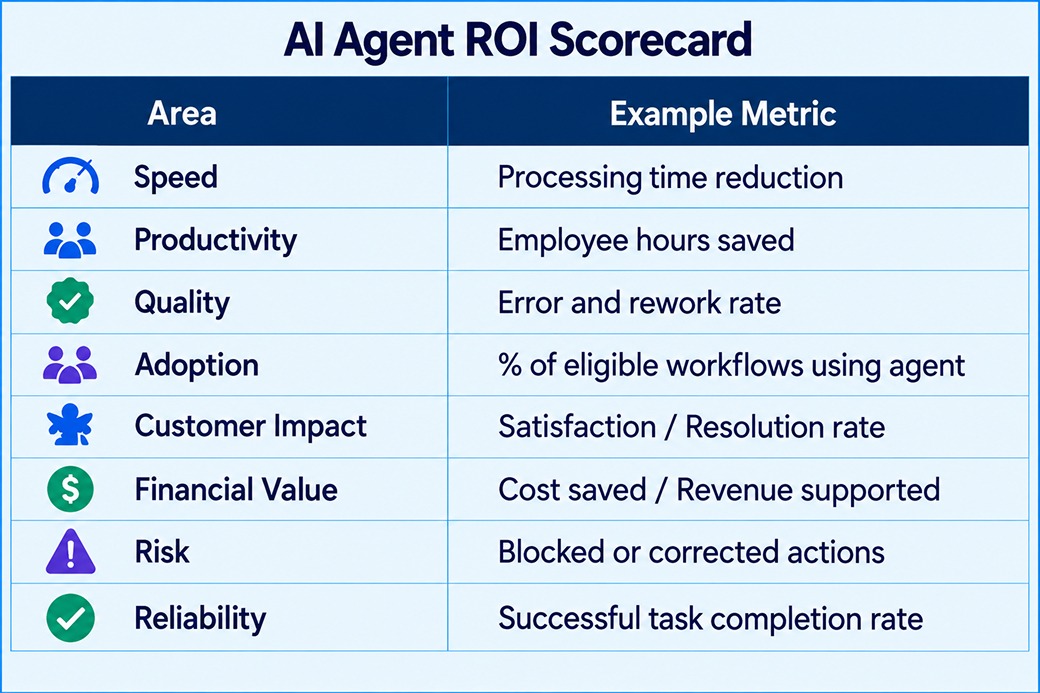
Suggested ROI scorecard
| Area | Example metric |
| Speed | Processing time before and after |
| Productivity | Employee hours saved |
| Quality | Error and rework rate |
| Adoption | Percentage of eligible workflows using the agent |
| Customer impact | Satisfaction or resolution rate |
| Financial value | Cost saved or revenue supported |
| Risk | Number of blocked or corrected actions |
| Reliability | Successful task-completion rate |
What Enterprises Have Learned So Far
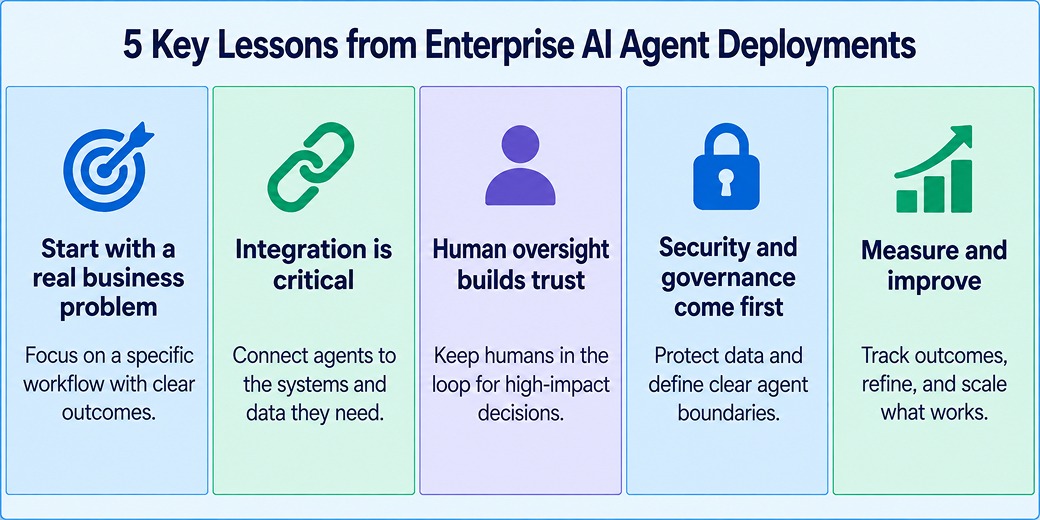
Lesson 1: Begin With a Workflow, Not a Technology Demo
A general agent that “helps with everything” is difficult to test, secure and measure.
A focused agent is more practical.
Good starting points usually have:
- A clear beginning and end
- Frequent manual work
- Repetitive decisions
- Available digital data
- Defined policies
- A measurable outcome
- Manageable risk
“Reduce invoice follow-up time” is a better project goal than “implement agentic AI.”
Lesson 2: Integration Is Often Harder Than the AI
The language model is only one part of an enterprise agent.
A working system may need to connect with:
- CRM
- ERP
- HRMS
- Document management
- Customer support software
- Identity systems
- Internal APIs
- Reporting tools
- Approval workflows
EY’s 2026 India report found that 78% of surveyed enterprises struggled with system integration. It also reported that 64.5% considered data governance and security to be very severe challenges.
This is why AI agent integration should be planned early. An impressive prototype may fail in production when data is incomplete, APIs are unreliable or permission rules are unclear.
Lesson 3: Human Oversight Is a Design Feature
Human review should not be viewed as proof that an AI agent has failed.
For many enterprise workflows, human approval is the correct design.
Approval may be required before an agent:
- Sends a legal or sensitive communication
- Makes a payment
- Changes a customer contract
- Updates financial records
- Deletes information
- Changes system access
- Rejects an applicant
- Makes a clinical recommendation
- Takes an action with regulatory impact
A good human-in-the-loop AI design explains what the agent recommends, what information it used and what will happen after approval.
As trust and performance improve, the organization may gradually automate more low-risk actions.
Lesson 4: Security Must Follow the Action, Not Just the Answer
A chatbot that generates an incorrect answer creates one type of risk.
An agent that performs an incorrect action creates a much larger risk.
McKinsey’s 2026 AI Trust Maturity Survey found that nearly two-thirds of respondents viewed security and risk concerns as the main barrier to fully scaling agentic AI. The report also found that only around 30% of organisations had reached higher maturity levels in strategy, governance and agentic AI controls.
Secure enterprise AI agents should therefore follow the same security principles as other enterprise applications:
- Give each agent a clear identity
- Use role-based access control
- Apply least-privilege permissions
- Separate read access from action permissions
- Protect credentials and API keys
- Log every important action
- Validate external inputs
- Limit which tools the agent can use
- Require approval for high-risk actions
- Test for prompt injection and data leakage
- Monitor unusual behaviour
- Provide an immediate way to stop the agent
Security should be built into the agent architecture. It should not be added only after the pilot is complete.
Lesson 5: Governance Cannot Be a Separate Document
AI agent governance must be visible in the day-to-day operation of the system.
Every production agent should have:
- A business owner
- A technical owner
- A defined purpose
- Approved data sources
- Permitted actions
- Prohibited actions
- Human-approval rules
- Performance targets
- Risk limits
- Review dates
- Incident procedures
Governance becomes especially important when several departments create their own agents. Without common standards, organisations may end up with duplicated tools, inconsistent security and no clear view of which agents can access sensitive systems.
Lesson 6: Reliability Matters More Than a Perfect Demo
A prototype may work well during a prepared demonstration and still fail under real business conditions.
Production systems must handle:
- Missing information
- Conflicting data
- API failures
- Long-running tasks
- Duplicate requests
- Permission changes
- Unexpected user instructions
- Model errors
- Business-rule exceptions
The right question is not:
“Did the agent complete the demo?”
The better questions are:
- How often does it finish the task correctly?
- How often does it need human help?
- Can it recover when a tool fails?
- Can we explain what it did?
- Can we reverse an incorrect action?
- Does it know when to stop?
Observability, testing and fallback workflows are central parts of AI agent orchestration.
A Practical Roadmap for AI Agent Implementation
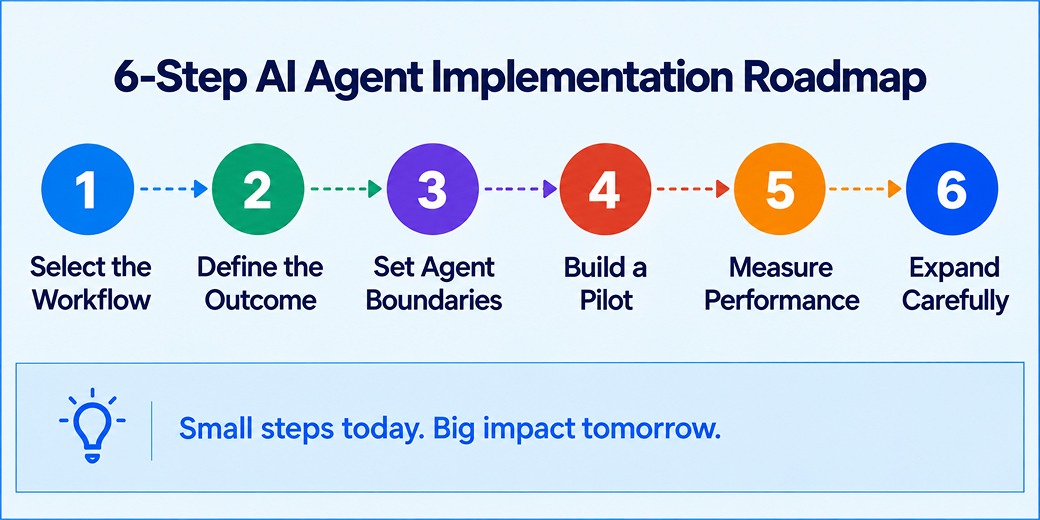
Enterprises do not need to automate a complete department in the first release.
A controlled implementation can follow six stages.
Stage 1: Select the workflow
Choose one specific workflow with measurable pain. Document the current steps, systems, delays and exceptions.
Stage 2: Define the business outcome
Decide whether success means faster processing, fewer errors, reduced cost, improved service or additional capacity.
Stage 3: Set the agent’s boundaries
Define what the agent can read, what it can change and which actions require approval.
Stage 4: Build a controlled pilot
Test the agent with a limited group, restricted data and low-risk actions. Keep a manual fallback process.
Stage 5: Measure real performance
Compare the pilot with the existing process. Measure time, quality, cost, adoption, reliability and user feedback.
Stage 6: Expand carefully
Increase the agent’s permissions or workflow coverage only after it reaches agreed performance and security standards.
This gradual approach reduces risk while giving the team enough real-world information to improve the system.
What Will Separate Successful Enterprises?
In 2026, access to AI models is not a major competitive advantage by itself. Most enterprises can use similar models, platforms and cloud services.
The difference comes from implementation.
Successful organisations are more likely to:
- Choose problems connected to business priorities
- Redesign workflows instead of automating every old step
- Prepare clean and accessible data
- Integrate agents with core systems
- Give agents limited and auditable permissions
- Keep humans involved in high-risk decisions
- Measure business outcomes from the start
- Train employees to work with agents
- Establish ownership and governance
- Improve systems based on production behaviour
McKinsey found that AI high performers were nearly three times more likely than other organisations to fundamentally redesign workflows. They were also more likely to define when model outputs required human validation.
The lesson is clear: enterprise AI adoption is not only an IT project. It requires changes in processes, responsibilities, controls and the way people work.
We help enterprises identify suitable AI agent use cases, design secure workflows and integrate agents with existing business systems.
Discuss Your AI Agent Use Case
Conclusion
Enterprise AI agents are moving business automation into a new phase.
Traditional automation follows fixed instructions. Generative AI creates content and answers questions. Agentic AI can interpret a goal, plan multiple steps, work with enterprise systems and perform controlled actions.
That makes it useful for customer service, IT support, finance, sales, HR, engineering, research, procurement and many other functions.
But more autonomy does not automatically create more value.
The strongest results come from focused use cases, reliable integration, measurable outcomes, human oversight and clear AI agent governance. Enterprises that treat agents as part of a larger workflow redesign are more likely to move beyond interesting pilots and achieve lasting business value.
The real opportunity in 2026 is not to create the highest number of autonomous AI agents.
It is to create a smaller number of secure, reliable agents that solve real problems and produce outcomes the business can measure.
Frequently Asked Questions
-
What are enterprise AI agents?
Enterprise AI agents are AI-powered software systems that can understand business goals, plan tasks, use approved tools and perform actions across enterprise applications. They differ from basic chatbots because they can complete multi-step workflows instead of only providing information.
-
How are enterprises using AI agents in 2026?
Enterprises are using AI agents in customer service, IT support, finance, HR, sales, software development, knowledge management, procurement and supply-chain operations. The most common deployments focus on repetitive workflows with clear rules and measurable outcomes.
-
What is the difference between AI agents and traditional automation?
Traditional automation follows predefined rules and fixed sequences. AI agents can interpret instructions, select tools, adapt their plan and handle some variation in the workflow. However, traditional automation may still be more reliable for stable, highly predictable processes.
-
What is the difference between generative AI and agentic AI?
Generative AI mainly produces content such as text, images, summaries or code. Agentic AI uses AI models to plan and perform tasks. It may generate content as one step, but its main purpose is to achieve an outcome through actions.
-
What are the benefits of AI agents for business?
Potential benefits include faster processing, lower administrative effort, better data quality, shorter customer-response times, fewer manual handovers and improved employee productivity. The actual value depends on workflow design, integration quality and adoption.
-
Do AI agents need human oversight?
Yes, particularly when an action affects money, customer rights, employment, healthcare, legal obligations, security or sensitive data. Human approval should be applied according to the risk and impact of each action.
-
How can enterprises measure AI agent ROI?
Enterprises can measure AI agent ROI through time saved, cost per transaction, reduction in errors, revenue supported, customer-service improvement and additional operational capacity. Model, infrastructure, integration, monitoring and human-review costs should also be included.
-
What are the main risks of enterprise AI agents?
The main risks include incorrect actions, data leakage, excessive permissions, prompt injection, unreliable outputs, poor system integration and unclear accountability. These risks can be reduced through limited access, human approval, monitoring, audit logs and regular testing.
-
Should a company use one AI agent or multiple agents?
A single agent is usually better for a focused workflow. Multi-agent systems may be useful when a complex process contains clearly different responsibilities. Companies should choose the simplest architecture that can reliably achieve the required outcome.
-
How should an enterprise choose its first AI agent use case?
Start with a frequent, repetitive and measurable workflow. The process should have clear data, defined rules, manageable risk and a business owner. Avoid beginning with a broad agent that is expected to perform many unrelated tasks.


