

These days, you hear it everywhere: AI will cut software development costs by 30-50%.
And honestly, sometimes it does. But that statement is incomplete because AI tools don’t magically fix the real reasons projects become expensive: unclear scope, shifting requirements, inconsistent quality, weak testing, slow reviews, production issues, and lack of ownership. In fact, if you introduce AI into a messy delivery system, it often makes the mess happen faster.
The teams that truly see transformation don’t just “buy AI.” They build an AI-ready engineering organization-people trained in the right skills, working within the right process, under sensible governance, supported by a focused tool set.
If your organization is exploring AI adoption in engineering, our AI development services can help structure your transformation roadmap with the right balance of tools, skills, and delivery discipline.
Table of Contents
What Transformation Really Means and Why Speed Alone Doesn’t Count
A lot of AI discussion is stuck on one narrow idea: developers code faster. But software delivery cost isn’t just writing code. It’s everything around it:
- Understanding the business goal
What problem are we solving? Who uses it? How will we know it worked?
- Translating ideas into precise requirements
Clear user stories, acceptance criteria, and the edge cases that break the feature in real life.
- Designing the solution
Data model decisions, API contracts, permissions and roles, plus performance and scalability planning.
- Making it safe and correct
Testing, QA cycles, regression prevention, and monitoring/logging that helps you debug quickly.
- Maintaining it after release
Bug fixes, enhancements, refactors, security patches, and ongoing production support.
So a Transformed Team isn’t just Faster
A transformed team is faster without becoming reckless. That shows up in real outcomes:
- Shorter lead time: Idea to production happens quicker and more reliably.
- Lower rework: Fewer “we built the wrong thing” iterations.
- Higher quality: Fewer escaped bugs and production fires.
- More consistent delivery: Fewer surprises at the end of sprints.
- Lower total cost: Build + QA + maintenance truly goes down.
Why AI Tools Alone Often Increase Cost
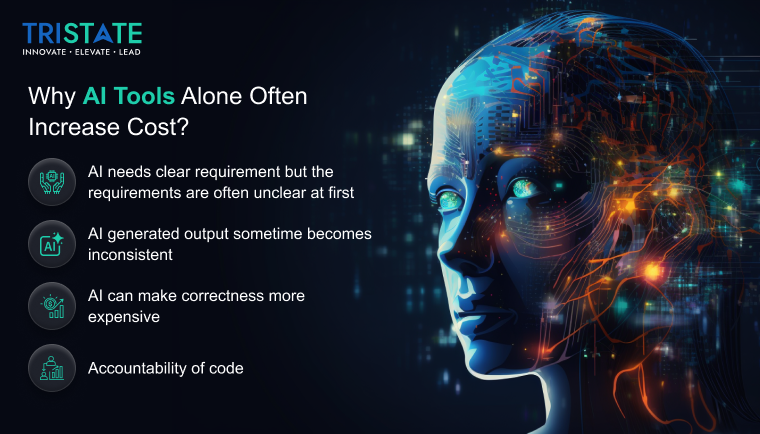
Let’s be very honest: many teams spend more after adopting AI tools—not because AI is bad, but because they’re using it inside a broken workflow.
1) AI needs clear requirement but the requirements are often unclear at first.
When you have a requirement like “Create an onboarding flow”, AI can generate something that looks correct but without clear rules, edge cases, and a shared definition of done, you end up building quickly in the dark.
Common hidden costs are:
- Moving fast in Wrong Direction:It may happen that the features are delivered, but key business rules are missed.
- Late feedback: The client reviews it and says, “This is not what we meant.”
- Costly rework under pressure: Major changes are required late in the timeline, when deadlines are already tight.
2) AI generated output sometime becomes inconsistent
Each developer uses AI in their own way so you get a codebase that feels like it was written by different teams.
Symptoms you will notice :
- Style Difference: There might be Different patterns and naming conventions across modules.
- Duplicate solutions: The same functionality is implemented in different ways.
- Slow reviews: Reviewers spend extra time understanding different styles and approaches.
3) AI can make correctness more expensive
AI can generate a lot of code very quickly but correctness will require careful review, test coverage, proper integration, validation against test cases, and security checks.
4) Accountability of code
AI tools are powerful, but they don’t take responsibility. People do.
If a culture develops where “AI wrote it” becomes an excuse then engineers stop verifying output deeply, and reviews become shallow, defects rise and reliability may drops.
The Real Formula is Tools + Skills + Operating System
Teams that succeed with AI don’t treat it like a gadget. They treat it like a capability.
Transformation happens when three things come together:
- Right AI tools: Selecting the right AI tools is important.
- Right AI-enabled skills: The Team must have the right AI enable skills.
- Right operating system: Proper process , governance and metrics must be in place.
1) The Right AI Tools
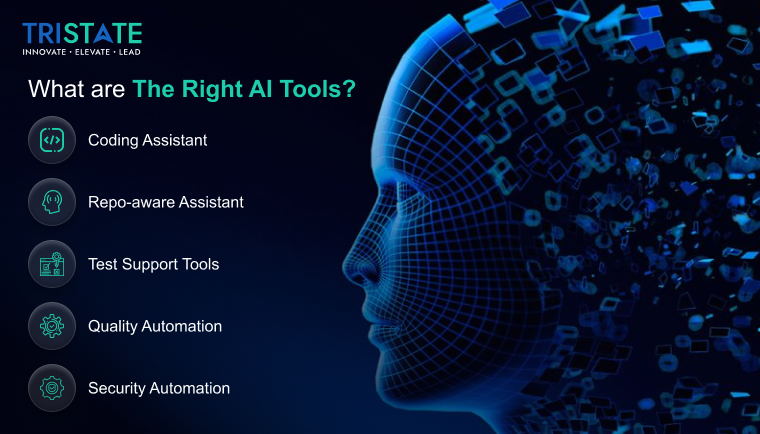
Most teams overdo tools. They subscribe to multiple assistants, multiple chat platforms, multiple code analyzers, and create confusion.
The goal isn’t “use AI everywhere.” The goal is: use a few tools consistently to improve delivery outcomes.
Here’s a sensible tool stack-and what each one should achieve:
A) Coding Assistant
Helps generate small code changes quickly, suggests refactors, explains unfamiliar code, and keeps repetitive work consistent. But it should not replace architectural decisions.
B) Repo-aware Assistant
Helps follow your folder structure, match naming conventions, reuse existing utilities, and avoid inventing patterns that don’t belong in your codebase.
C) Test Support Tools
Helps create unit tests, edge-case tests, contract tests, and regression tests. If you don’t strengthen testing, AI savings won’t stick.
D) Quality Automation
Keeps code consistent across developers, reduces review noise, catches basic mistakes early, and prevents style drift when AI generates code.
E) Security Automation
At minimum, use dependency scanning, secrets scanning, and basic SAST checks. AI can unknowingly suggest insecure patterns, so automation is your safety net.
Rule to keep it Simple
If a tool isn’t improving measurable outcomes (cycle time, defects, rework), remove it.
2) Skills: What an AI-Ready Team Learns
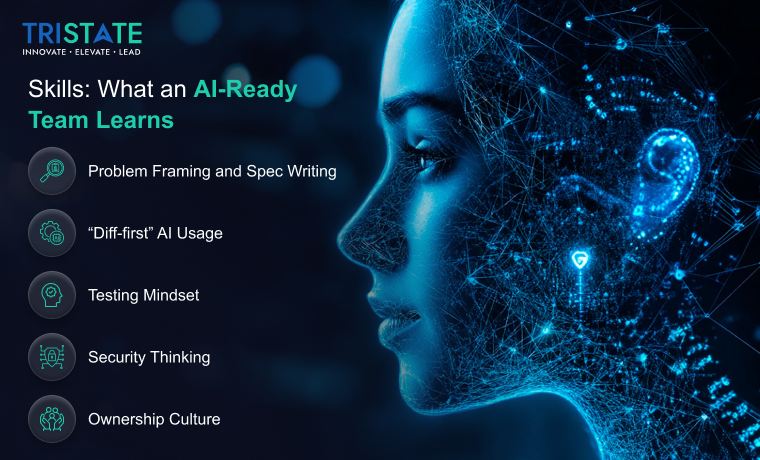
Here’s the truth: prompting skills are useful, but they’re not the main driver of transformation.
The main driver is how clearly your team thinks and communicates.
A) Problem Framing and Spec Writing
An AI-ready engineer can take a vague request and produce clarity: acceptance criteria, constraints (performance, security, data handling), edge cases, and non-goals. When this is done before coding, AI becomes useful. Without it, AI becomes expensive.
B) “Diff-first” AI Usage
Winning teams use AI for targeted changes: handle an edge case and add tests; add validation without changing unrelated behavior; refactor to reduce complexity while keeping output identical. Losing teams ask for full rewrites or end-to-end features in one shot. Small diffs mean easy review and safer releases.
C) Testing Mindset
AI-ready teams generate tests alongside features, require regression tests for bug fixes, and write tests based on acceptance criteria—not assumptions. If you want lower cost, you need fewer regressions. Testing is the engine.
D) Security Thinking
AI can suggest weak auth checks, insecure file handling, unsafe inputs, missing rate limiting, or risky dependencies. AI ready teams will make sure that users can access only what they will be allowed and validate all inputs, keep passwords and keys secure, avoid storing sensitive information in logs, and follow safe default settings in the system.
E) Ownership Culture
Follow a simple rule that if you add code, you are responsible for it. You should understand what the code does and be able to explain it. You should have tests to show it works and fix it if something breaks. This ensures AI helps the team instead of creating confusion.
3) Operating System: Process + Governance That Enables Speed
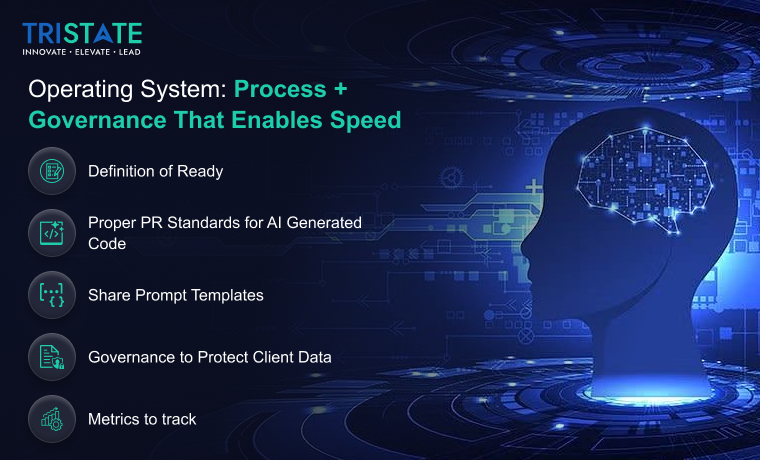
This is where transformation becomes predictable, not random.
A) Definition of Ready
Before work starts, a ticket should include what success looks like, what’s out of scope, edge cases, dependencies, and a testing approach. This prevents building the wrong software.
B) Proper PR Standards for AI Generated Code
AI is helpful teams in writing code faster so strong PR standards are important to maintain good code quality. Pull requests should be small so they are easy to review. They should explain what was changed and why, include tests for any new or updated functionality, and mention any security concerns. Reviews should focus on whether the code works correctly and will be easy to maintain in the future.
C) Share Prompt Templates
Create shared prompt templates for common development tasks like building features with proper rules and tests, refactoring code without changing how it works, updating APIs with validation and error handling, fixing bugs with regression tests, and writing documentation. This helps everyone on the team follow the same approach and maintain consistent code quality.
D) Governance to Protect Client Data
The team should use only approved AI tools for client work, never share passwords, personal data, or confidential client information in external tools, and rely on automated security checks during development. These rules are meant to protect client data while avoiding unnecessary delays or extra paperwork.
E) Metrics to track:
- Cycle time
- Escaped bugs
- Rework rate
- PR review time
- Regression frequency
AI transformation should show up in these numbers. If it doesn’t, something is wrong.
AI tools alone won’t reduce your costs. Our experts help you implement AI with the right governance, testing, and delivery framework.
Schedule Free AI Consultation
Conclusion
AI is not a shortcut around engineering discipline. It is an amplifier. If your system is strong, AI makes you faster and cheaper. If your system is weak, AI makes you faster at building problems.
The teams that truly transform don’t just buy tools. They build AI-ready capability: skills, process, standards, governance, and measurable improvement.
That’s the difference between “we use AI” and “AI changed how we deliver.”


