


Every day, healthcare leaders make decisions that affect patient care. Some of those decisions happen in operating rooms and clinical settings. But one of the most important decisions you will ever make happens long before any patient walks through the door. It happens when you choose who will build your digital systems.
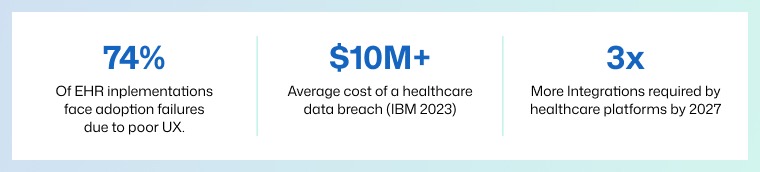
The right healthcare software development partner does more than write code. They help you rethink how patients access care, how your clinical teams communicate, how compliance works without slowing everyone down, and how your organization stays flexible as the industry changes. The wrong partner can leave you with software that technically works but does not fit your clinical reality. Worse, it could create security gaps, compliance risks, or an experience so frustrating that your staff never fully adopts it.
This is not just a technology decision. It is a decision about trust, outcomes, and your organization’s future. Here is how to make it well.
Table of Contents
1. Start With the Patient, Not the Proposal
Most organizations begin searching for a software partner by looking at price, timelines, and credentials. That makes sense. But healthcare software is different from almost every other kind. It sits right at the intersection of clinical work and human lives.
When a patient portal fails to show the right information, patients miss follow-up care. When a scheduling system breaks down, appointments get disrupted. We have seen this happen in clinics where the front desk team had to move back to phone calls and spreadsheets just to manage the day. When billing is poorly designed, payments slow down and your staff ends up doing extra work. And when data security is weak, you risk damaging patient trust, facing compliance problems, and in serious situations, affecting care itself.
The right partner understands what is at stake. They do not treat your project like a generic software job. They treat it like the mission-critical work it is.
Key Signal
When you meet with a potential partner, pay attention to the questions they ask. Do they ask about your patients? Do they want to understand how your clinical teams actually work? Do they talk about outcomes, or just about features and deadlines?
The best healthcare software companies come to the table genuinely curious about the people their software will serve, including clinicians, administrators, and patients. If a potential partner goes straight to timelines and tech without asking about the people involved, that tells you something important.
2. Domain Knowledge Is Not a Bonus. It Is the Starting Point.
There are many skilled software development companies out there. Very few of them are actually equipped to build healthcare software. The difference is not about talent or intelligence. It is about domain knowledge, and that knowledge matters a great deal.
Healthcare runs on a specific set of rules, workflows, and standards that do not exist in other industries.
HIPAA in the United States, HL7 and FHIR for health data exchange, ICD-10 coding, DICOM for medical imaging, NCPDP for pharmacy communication. These are not optional extras. They are the basic grammar of healthcare software. A partner who does not know this language will make expensive mistakes, often without realizing it.
Beyond regulations, clinical workflows have their own logic that software must follow. A patient’s journey through a healthcare system involves dozens of handoffs between people, systems, and departments. A partner who treats this like a simple user flow will build something that frustrates your clinical staff and never gets properly adopted.
When you evaluate partners, go deeper than their portfolio. Ask them to walk you through how they have handled EHR integration with systems like Epic, Cerner, or Athena health. Ask how they approach access control in a clinical setting, where a nurse, a doctor, a billing specialist, and a patient all need different views of the same record. Ask what they know about your specific area, whether that is telemedicine, care coordination, diagnostics, or insurance workflows.
What To Look For In The Team
Do they have clinical consultants or people with healthcare operations experience alongside their engineers? Have they worked directly with hospital staff, nursing teams, or billing departments during the discovery process? Having clinically informed team members is a strong sign that a partner takes this seriously.
A partner with real domain knowledge will answer your questions well and ask sharp questions of their own. That is the kind of conversation you want.
3. Security and Compliance Cannot Be an Afterthought
In healthcare software, security is not something you add near the end of a project. It has to be part of the foundation from the very first conversation.
When security is treated as an afterthought, the consequences go far beyond fines. It can expose patient information, damage your organization’s reputation, and in serious cases, affect patient care directly.
A trustworthy healthcare software partner will bring up security early. They will not wait for you to ask. During discovery, they should be comfortable talking through encryption, access controls, audit logs, data storage, breach response, and compliance requirements.
Healthcare platforms must be designed around strong HIPAA compliance requirements from day one. They should also understand that HIPAA compliance is not a one-time checklist. It is something your software has to support every single day, even years after launch.
In plain terms, strong healthcare security includes:
- Role-based access control : Every user should only see what they need to do their job. A patient sees only their own records. A doctor sees the patient information relevant to care. An admin handles scheduling or billing tasks. No one gets access to data that is not theirs to see.
- Data encryption : Patient information should be protected when it is stored and while communication between different devices. This is a basic requirement, not an advanced feature.
- Audit logs : The system should record who accessed what, when and from where. This is very important for compliance, monitoring, and investigating any problems that come up.
- Compliance ready design : The software should be built with HIPAA, HITECH, and other relevant regulations in mind from day one.
- One more thing worth checking: Your software partner should also follow strong security practices internally. They should have Business Associate Agreements ready, clear internal security policies, and a process for managing the third-party tools, APIs, and libraries they use in your project.
Before you sign with a healthcare software partner, ask them these three questions.
Have they supported a healthcare client through a HIPAA audit? How do they handle security issues after the product is live? What do they do if there is a data breach? Their answers will tell you a lot about how seriously they take this.
4. Build for Where Healthcare Is Going, Not Just Where It Is Today
Healthcare is not slowing down. Wearable devices are producing continuous health data. Pharmacy automation is changing how medications are managed. Insurance platforms want tighter claims integration. Diagnostic labs are moving toward real-time results. The software you build today needs to grow with these changes, not be rebuilt from the ground up every time something shifts.
That makes integration and scalability two of the most important things to look for in a healthcare software partner.
Systems that are built for integration use HL7 FHIR interoperability standards, which allows health data to move securely and consistently across EHR platforms, billing systems, lab networks, pharmacy systems, insurance platforms, and wearable devices. Without this foundation, you end up with a technical island that will eventually need expensive bridges to connect to everything else.
Scalability means your system can handle more users, more data and more complex features. Cloud-native infrastructure, microservices, and API-first design all help make a system easier to grow, connect, and maintain over time.
Ask your potential partner to show you examples of scalable healthcare solutions they have built before. Ask to see systems that started as single-clinic tools and expanded to multi-facility networks. The answer will tell you a great deal about how they think about the future.
This may sound basic, but it is often missed. They design for what you will need in three years and leave room for what you cannot yet predict.
“A good healthcare software partner does not just build what you need today. They design for what you will need in three years and leave room for what you cannot yet predict.”
5. AI Is Only as Good as What It Is Built On
Artificial intelligence has real, meaningful potential in healthcare. Predictive diagnostics, clinical decision support, automated prior authorization, smarter appointment scheduling, anomaly detection in lab results, documentation tools powered by natural language processing are some of the use cases of AI. But here is something many organizations overlook. AI is only as powerful as the system underneath it.
AI models need clean, organized, well-labeled data to produce meaningful results. If your underlying systems are fragmented, inconsistently structured, or siloed across platforms that do not talk to each other, AI will not fix that. It will make the mess worse. Organizations investing in AI development services should first ensure their core infrastructure is capable of supporting scalable and reliable AI implementation.
What does “AI-ready” actually look like across your platform?
The best healthcare software partners will design your platform with AI in mind from the start, not as a feature to bolt on later. They will ask questions like:
- Where are your staff spending time on tasks that could be automated?
- What clinical decisions would benefit from better data?
- How can we structure your data today so that future AI tools can actually use it?
That kind of thinking is worth demanding from a partner.
6. The Right Partner Stays With You After Launch
One of the most common mistakes service providers make is treating a software project as something you complete and move on from. Healthcare software does not work that way.
Your platform needs to keep improving as your organization grows, patient needs change, regulations are updated and new technology becomes available. That is why the relationship with your software partner matters just as much as the product they deliver.
A good partner does not hand over the finished product and disappear. They stay involved through planning, development, launch, ongoing support, and future improvements.
What does a real long-term partnership look like in practice?
PHASE 01
Discovery
A good partner spends time learning your clinical workflows, user roles, compliance requirements, existing systems and integration needs. Discovery is not a formality. It is where good software actually begins.
PHASE 02
Design
Thoughtful UI and UX based on how your clinical staff and patients really work. Healthcare software has a well-documented history of usability problems. Design that puts the clinician and the patient first is worth every bit of investment.
PHASE 03
Development and QA
Healthcare-specific quality checks including security testing, load testing and full end-to-end integration testing before anything goes live.
PHASE 04
Launch
Careful cutover planning is essential. Moving from one system to another in a healthcare environment requires proper preparation, staff training, testing in advance and a clear backup plan.
PHASE 05
Ongoing long-term support
After launch, your partner should stay involved. They should monitor performance, catch problems early, support compliance reviews and help you add new features as your needs evolve.
7. The Questions That Help You Find the Right Fit
Here are the questions that will tell you the most in a real conversation with a potential partner:
A partner who can answer these questions with real specifics, honest candor and genuine curiosity is the one worth trusting with your organization’s future.
The Decision That Shapes Everything
Choosing the right partner is one of the most important decisions you will make. It will shape how your patients experience care, how your clinical teams operate, and how your organization handles a rapidly changing regulatory and technology landscape.
Do not settle for a software vendor. Find a partner who is genuinely invested in your mission. Someone who will work through discovery with you, design alongside you, build with care and stay with you as your organization grows.
That kind of partnership is where the future of healthcare is actually being built. Make sure you are building it with the right team.


