

“This next generation of AI will reshape every software category and every business, including our own.” – Satya Nadella, CEO, Microsoft
Nadella said that in front of thousands of enterprise leaders. Most nodded, then returned to operations running exactly as before.
Here is what that hesitation is costing you. McKinsey’s 2025 State of AI report found that enterprises actively deploying generative AI for enterprises across multiple functions are already recording measurable gains in revenue and operational costs. Those still in the pilot stage? Only 39% report any EBIT impact at the enterprise level.
Gartner adds a number worth sitting with: by 2028, 40% of large enterprises will deploy AI to directly analyze and respond to employee behavior as a calculated profit strategy.
As a decision maker, you need a clear and tested roadmap to build enterprise AI solutions that generate real returns. This guide gives you exactly that, covering everything about generative AI solutions for enterprises in 2026.
This guide gives you the complete roadmap to catch up and lead.
Table of Contents
What Is Generative AI for Enterprises?
And Why It Has Nothing to Do With the AI You Use Personally
Generative AI for enterprises refers to the use of advanced models such as Large Language Models and foundation models within business workflows, where they operate under strict controls to automate tasks, generate outputs, and analyze internal data that drives decision-making.
You have likely used ChatGPT to draft an email or summarize information. That experience feels useful at an individual level, but it sits firmly in the category of conversational AI.
Understanding the difference between Conversational AI vs Generative AI matters here because enterprise deployments operate at a completely different level, where scale, accuracy, and accountability directly impact business outcomes.
When your organization deploys enterprise AI solutions, the system runs inside your environment, where it accesses approved internal data, connects with existing tools, and produces outputs that align with defined business controls. Every action remains traceable. Every output can be reviewed.
Consumer AI tools lack visibility into your business and workflows, which is why outputs stay generic and cannot support decisions that require precision.
How Enterprise GenAI Actually Differs From Consumer AI Tools
If a vendor is pitching you an AI product and cannot clearly answer these five questions, walk away. These are the pillars that define whether an AI solution is genuinely built for enterprise operations or simply dressed up to look like one.
1. Security
Consumer AI runs on shared infrastructure with limited visibility and control, while enterprise AI operates in secure environments that keep your data fully contained within your organization.
2. Data Privacy
Enterprise systems don’t get a choice when it comes to data privacy. They have to meet regulatory requirements and handle sensitive information properly, because the risk is real.
Consumer AI tools weren’t built with that level of responsibility in mind, which is why they often fall short in regulated environments.
3. Scalability
A tool that works for one person doesn’t automatically work for an entire organization. Enterprise systems are built to handle multiple teams, overlapping workflows, and constant usage without slowing things down. That’s a very different requirement from individual use.
4. Governance
This is where most AI conversations get serious. In an enterprise setting, you need to know what the system is doing, who is using it, and how decisions are being supported.
Audit trails and access controls aren’t “nice to have.” They’re what make the system usable in the first place.
5. System Integration
One of the biggest gaps with consumer AI is that it sits outside your actual work.
Enterprise AI only becomes useful when it connects directly to the systems your teams already rely on, whether that’s CRM, ERP, or internal databases. Otherwise, it just creates more manual steps instead of removing them.
The Three AI Models Powering Enterprise GenAI in 2026
You do not need to understand how these models are built, but you need to know what they solve.
Large Language Models
Large language models are what handle most of the text work. Writing, summarizing, making sense of information.
In practice, they’re what teams use when they need quick answers or first drafts without starting from scratch. Other models pick up where they don’t fit, especially for visuals or mixed data.
Diffusion Models
Diffusion models are used when the output is visual. Product images, marketing creatives, design variations. Instead of waiting on full design cycles, teams can generate and iterate much faster.
For retail, marketing, and product teams, generative AI for retail reduces creative production timelines by generating high-quality visual assets on demand without traditional agency cost or delays.
Multimodal AI
Multimodal AI enables generative AI enterprise use cases for complex operations by processing text, images, audio, and structured data within a single workflow.
A multimodal system can read a vendor contract, extract key terms, check compliance policies, flag deviations, and deliver a structured summary without manual handoffs.
Consumer AI vs Enterprise GenAI: The Honest Comparison
| Feature | Consumer AI | Enterprise GenAI |
| Data privacy | Public servers, no control | Private deployment, your boundaries |
| Security | None | Role-based access, encryption, audit logs |
| System integration | Standalone, disconnected | Connected to your CRM, ERP, databases |
| Scalability | One user at a time | Entire organization, simultaneously |
| Governance | No oversight | Full audit trails, compliance ready |
| Output accountability | Untraceable | Every output logged and attributable |
| Customization | Generic responses | Trained on your data and terminology |
| Regulatory compliance | Not designed for it | Built for GDPR, HIPAA, EU AI Act |
Why 2026 Is the Year Enterprises Move from Piloting to Deploying
For the past two years, enterprise leaders ran careful pilots and waited. That caution made sense then. In 2026, the enterprise generative AI market has moved into full operational deployment across major industries.
Companies with a clear enterprise AI adoption strategy are seeing the benefits of generative AI in revenue growth, reduced operational costs, and faster decision-making.
The next section shows you exactly where those results are coming from, department by department.
What Your Business Actually Gains When AI Works Inside Your Operations
Most conversations about AI benefits stay frustratingly vague. Productivity improvements, cost savings, and better decisions mean nothing until you connect them to something specific happening inside your business, which is where generative AI for business transformation starts to show real, measurable impact.
So let’s get specific.
The ROI Breakdown Your CFO Needs to See
Enterprise GenAI delivers returns across three areas. Understanding all three helps you build a business case that survives any finance committee.
Productivity Gains
The best paid people in your organization waste time working on tasks which do not require their skill sets, such as clause review, report formatting, and proposal writing. Enterprise AI applications minimize time spent on repetitive, information-intensive tasks that allow skill-based professionals to engage in decision-making activities.
According to McKinsey estimates, generative AI applications in enterprises can create up to $2.6 and $4.4 trillion annually in business operations.
Cost Reduction
Operating costs are generally embedded in manual processes such as document management, data entry, and customer interaction.
Through automation of these processes, cost savings are achieved and productivity is increased, enabling businesses to scale without a corresponding increase in employees.
Revenue Acceleration
Rapid development of proposals assists in speeding up sales processes, personalization contributes to more conversions, and quick solving of client issues ensures that clients are retained.
Utilization of generative AI technology in sales and marketing helps in generating revenue, and evidence of positive outcomes through personalization is seen in retail.
Quick Wins in 30 to 90 Days vs Long-Term Transformation
The results of using generative AI technology are not expected to take years. With the right application scenario, results will become evident after 30 to 90 days, including improved response times, shortened proposal processes, and fast review of documents. The impact is long-term when these achievements spread across departments.
The Competitive Risk of Not Adopting the Generative AI
Competitors have the opportunity to reduce their costs, expedite closing of deals, and enhance their customer experience with each quarter of non-adoption. Expectations are rising and organizations delaying the adoption of generative AI face risks of losing both customers and staff members.
The benefits of generative AI for companies that move now compound over time. Waiting does exactly the same thing, just in the opposite direction.
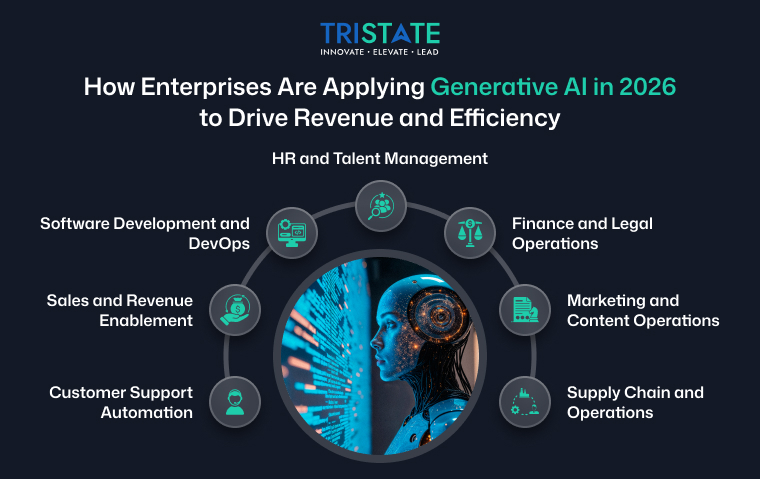
How Enterprises Are Applying Generative AI in 2026 to Drive Revenue and Efficiency
Every enterprise leader asks the same question when AI comes up in the boardroom: where exactly does it make a difference inside a real business?
The answer is not limited to one department. Generative AI enterprise use cases are already running across legal, finance, sales, HR, marketing, and supply chain at the same time.
Every use case below is backed by a real organization that built it and recorded a result worth your attention.
1. Customer Support Automation
Support teams were never built to handle everything instantly, but that’s what customers now expect. What’s changing is how those routine questions get handled. Instead of sitting in queues, a lot of them are answered directly using internal documentation.
Goldman Sachs, for instance, uses an internal assistant that takes care of a large share of employee queries, so teams only step in when something actually needs judgment.
2. Sales and Revenue Enablement
If you look closely, a big chunk of sales time goes into prep work. Writing emails, pulling together proposals, figuring out where to focus. With AI tied into CRM systems, much of that gets handled in the background.
JPMorgan rolled this out widely, and the noticeable shift wasn’t just speed, it was how quickly teams could move from spotting an opportunity to acting on it.
3. Software Development and DevOps
Not every part of development is complex, but it still takes time. Small, repetitive tasks add up. Tools that assist with code suggestions, reviews, and testing help reduce that overhead.
Renault’s Ampere team took this further by using a system that understands their own codebase, which makes it more useful day to day rather than something generic.
4. HR and Talent Management
Your HR team handles the same questions about benefits, leave policies, and onboarding repeatedly every single week.
Generative AI solutions for enterprises automate those answers through Slack or your internal portal while simultaneously helping draft job descriptions, screen applications, and generate personalized onboarding materials.
Persol Career consolidated data from over 70 HR systems using AI, cutting data collection time from weeks to days and freeing their analysts for strategic work.
5. Finance and Legal Operations
Your finance and legal teams review hundreds of documents every month where most of the work is reading, extracting, and flagging rather than deciding.
Contraktor deployed contract analysis AI that reduced contract review and extraction time by 75%, letting their legal professionals focus entirely on the decisions that actually required their judgment rather than the reading that preceded those decisions.
6. Marketing and Content Operations
Your marketing team produces content across multiple channels, markets, and languages simultaneously. Generative AI enterprise use cases in marketing automate campaign copy generation, SEO optimization, and localization at a scale no human team can match independently.
Croud, a global media agency, uses custom AI workflows for data analysis, email sentiment analysis, and supplier-specific content, achieving productivity improvements of four to five times on repeatable marketing tasks.
7. Supply Chain and Operations
Your supply chain decisions depend on accurate demand forecasting, and manual forecasting at scale is both slow and error-prone. AI automation solutions analyze real-time operational data to predict demand, optimize inventory, and flag disruptions before they become costly problems.
Unilever uses AI to analyze weather patterns and monitor 100,000 smart freezers globally, improving demand forecasts and reducing manufacturing waste by 10% across key ingredients.
Every deployment above removed the part of the work consuming time without requiring expertise and gave that time back to the people who knew what to do with it. That is exactly what custom generative AI development services built around your specific operations deliver.
The next section shows you how to build that inside your own enterprise.
How Different Industries Are Using Generative AI for Enterprises in 2026
While the science of generative AI might not be what makes enterprise executives act, it is their understanding of the application of generative AI inside organizations dealing with similar levels of compliance requirements, customers, and other variables.
Here are some examples of industries using enterprise AI solutions that deliver proven results.
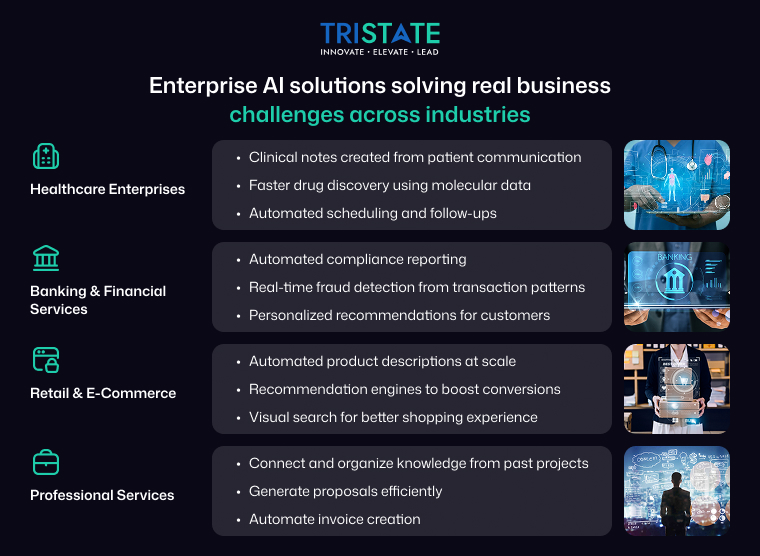
Generative AI for Healthcare Enterprises
Your clinical teams probably spend almost as much time on documentation than on patient treatment.
Generative AI automatically creates clinical notes based on communication with patients, freeing clinicians’ time.
In terms of drug discovery, AI solutions analyze molecular structures and related research materials in months, rather than years.
Generative AI solutions for patient engagement automate the entire schedule creation and follow-up processes.
Generative AI for Banking and Financial Services Enterprises
Your compliance department creates numerous reports that require considerable amounts of your analysts’ time.
With the help of generative AI solutions, compliance teams can quickly pull structured data and create audit-ready reports.
Real-time fraud detection systems analyze transaction patterns while personalized recommendations help increase conversion rates and retention.
Generative AI for Manufacturing Enterprises
The hidden cost of your generative AI in manufacturing floor could include unexpected machine downtime and quality issues during production.
Generative AI predicts possible equipment malfunctions ahead of time and notifies your manufacturing teams about any potential issues with quality.
Demand forecasting and logistic planning are done via AI automation.
Generative AI for Retail and E-Commerce Enterprises
The number of product listings in your catalog may range from hundreds to thousands, all in multiple markets and different languages.
Automated content production allows you to save time on writing descriptions, while recommendation engines increase conversion. Visual search eliminates possible friction in the shopping process.
Generative AI for Professional Services Enterprises
All the experience accumulated by your firm stays locked away inside your files and old projects.
Generative AI solutions create a system that connects information from all those places, making it searchable and helping your teams create proposals and invoices.
As you see, each industry leverages the power of generative AI to solve particular problems, such as reducing the time on documentation in healthcare, accelerating reporting in banking, or preventing production losses in manufacturing.
To benefit from the use of enterprise AI solutions, you should find out what activities in your company take too much of your employees’ time and implement generative AI there.
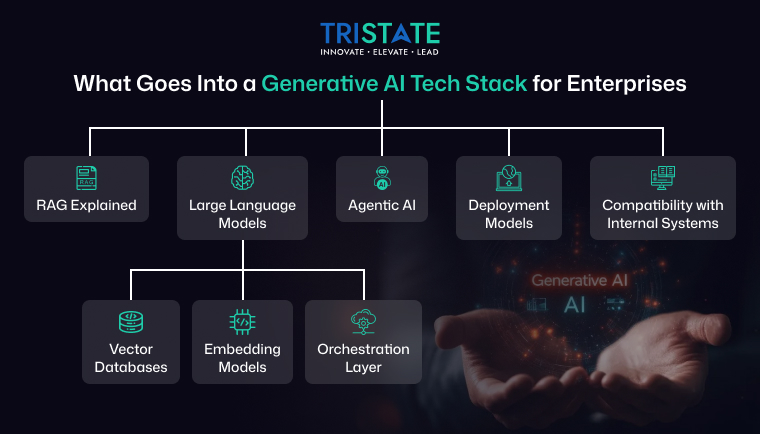
What Goes Into a Generative AI Tech Stack for Enterprises
It is easy to make a decision about implementing a new technology stack. However, when it comes to AI-based software, most business executives do not think through the details of their future solution. As a result, procurement becomes complex, security assessments become difficult, and collaboration with the technology team suffers due to a lack of clarity.
Core Components: What Every Enterprise GenAI System Is Built From
1. Large Language Models
Large Language Models form the core of your technology stack, where an LLM processes user inputs, understands context, and generates outputs based on requirements.
You need to decide whether to use cloud-hosted models such as GPT-4 and Claude 3 or open-source alternatives like LLaMA 3 and Mistral that run on your infrastructure. Depending on data sensitivity and the task, domain-specific models tuned to your industry may also be considered.
- Vector Databases
A vector database acts as your knowledge base, which takes internal content and turns it into meaning instead of words. The system searches for the required information based on similarity.
Pinecone, Weaviate, and MongoDB Atlas are among the best solutions.
- Embedding Models
An embedding model functions as a critical intermediary that converts textual data into numerical representations your system can store and search based on relevance. The accuracy of the output depends directly on the quality of the embedding algorithm used.
- Orchestration Layer
The orchestration layer manages how your AI operates, and retrievals, prompts creation and responses. Such tools as LangChain and LlamaIndex are good examples.
2. RAG (Retrieval Augmented Generation)
RAG stands for Retrieval Augmented Generation, which retrieves relevant data from your knowledge base and uses it as context while generating responses, ensuring accuracy and alignment with internal data.
3. Agentic AI
Agentic AI makes it possible for a system to perform certain actions such as vendor comparison, compliance checks, document generation, and workflow execution. Several agents can collaborate when necessary.
4. Deployment Models
Cloud deployment offers flexibility and lower upfront cost, while on-premise provides full control for sensitive data but is costly at the beginning. You can also opt for a hybrid solution.
5. Compatibility with Internal Systems
Compatibility with internal systems determines how effective your solution will be, since your AI must connect with CRM, ERP, HRMS, and other tools to use real business data. Integration becomes more complex when legacy systems lack modern connectivity, which requires careful planning.
All these components define how your AI functions and how well it performs in an enterprise environment. To avoid issues later, you need a clear understanding of how each component influences the final solution and its implementation.
A Practical Approach to Building an Enterprise Generative AI Strategy
Proper planning of an enterprise AI strategy eliminates inefficiencies, dead ends, and threats to security. To yield positive outcomes for the business through enterprise generative AI, decisions should be made following a strict sequence involving data, use cases, models, and governance.
Follow the steps outlined below to plan for successful implementation of enterprise AI solutions and generative AI development solutions for enterprises.
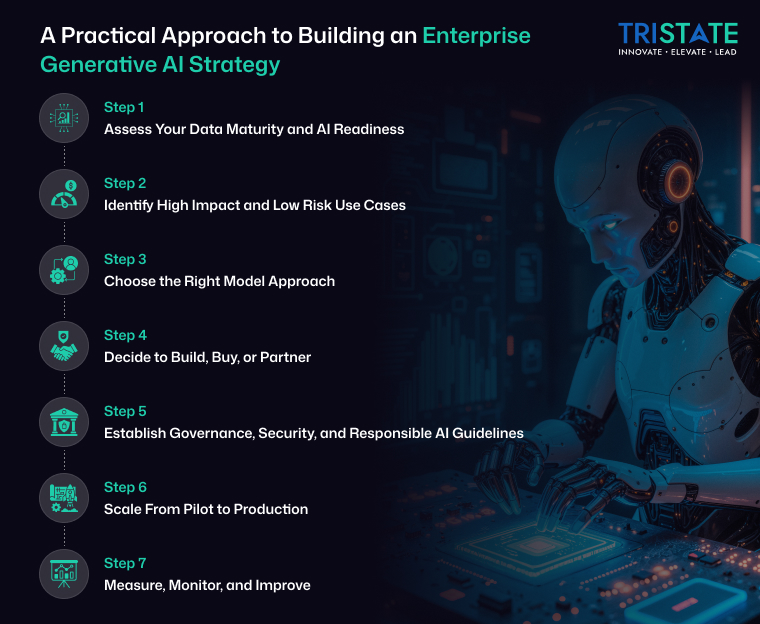
Step 1: Assess Your Data Maturity and AI Readiness
First, get a picture of data availability in your organization. Locate critical data in CRM systems, ERPs, documents, and operational systems. Determine its quality, accessibility, and permission issues.
Successful enterprise AI solutions depend on proper data pipelines, well-defined data ownership, and access control prior to selecting a model.
Step 2: Identify High Impact and Low Risk Use Cases
Find use cases that require significant manual work, occur frequently, and have quantifiable outcomes. Automation of customer support, document processing, and internal knowledge search usually lead to rapid gains. High-impact and low-risk generative AI use cases provide early success for businesses.
Step 3: Choose the Right Model Approach
Consider generative AI approaches based on the selected use cases. Pre-trained models work well for general purposes.
Retrieval-based models offer accuracy with data in the enterprise. Fine-tuned models suit domain-specific applications. The choice of the approach affects costs and results.
Step 4: Decide to Build, Buy, or Partner
Consider in-house generation, purchase of a generative AI product, or cooperation with a generative AI development company.
In-house development gives you full control but requires engineering competencies. Purchasing saves time but provides less flexibility. Partnering means receiving custom AI development services.
Step 5: Establish Governance, Security, and Responsible AI Guidelines
Set up rules for data access, monitoring, and audit. Define data management procedures and workflows. Enterprise AI solutions need to meet compliance and safety standards. Proper governance makes your generative AI solutions safe.
Step 6: Scale from Pilot to Production
Scale up validated pilots to production level by integrating them into existing workflows and systems. Align teams in technology, operations, and management. Enterprise AI solutions deliver business value when integrated into regular operations.
Step 7: Measure, Monitor, and Improve
Monitor key indicators like revenue, cost savings, cycle times, and quality measures of success. Continuously monitor performance of enterprise AI solutions. Keep updating models and workflows as needed.
The seven steps above determine how enterprise AI solutions perform. Each one affects success at different stages of planning and implementation of enterprise AI solutions.
When a framework like the one described above is in place, the next task is getting a clear picture of cost, ROI, and trade-offs related to implementation of generative AI solutions for enterprises at scale. This will be covered in the next section.
How Enterprises Manage Governance and Security in Generative AI
Generative AI for enterprises adds significant value in terms of efficiency and productivity, but there is always some level of inherent risk associated with such tools.
Since enterprise AI applications work with sensitive data and perform critical tasks that affect decisions and interactions with other applications and systems, they always have to work under strict control and accountability.
This chapter discusses the key controls needed to ensure safe, accurate, and reliable operation of enterprise AI systems.
Data Privacy and Compliance
Compliance with the regulations that apply to your business and operations is a must for every enterprise AI deployment. Data policy should cover all possible ways that your AI systems interact with sensitive data.
Sensitive data must remain within approved environments, and every interaction must follow compliance standards defined by your organization.
Hallucination Risks and Mitigation
Your AI models might sometimes produce inaccurate results. To minimize that risk, you need to rely on controlled access to data, data verification, and retrieval-based approaches.
When it comes to use cases that involve important decisions (legal, financial, etc.), you will need additional checks and validations.
Role Based Access Control and Data Segmentation
Your AI solution needs strict RBAC, and you will also need to segment your data based on sensitivity.
In most cases, users will need access only to sensitive data, which implies stricter access controls. However, in certain cases, they might be allowed to access other data as well.
Output Auditing and Human Oversight
Logging will allow you to monitor all the outputs produced by your enterprise AI solution. You can also audit each output for potential risks and mistakes.
For important decisions, human verification still remains crucial despite the use of AI. In many cases, it will not be enough to leave decision-making completely to machines.
Bias Detection and Model Monitoring
Regular bias analysis should become a standard procedure for every enterprise application of AI. Monitoring is required to ensure that output stays consistent and meets performance and accuracy requirements of your business.
Version control allows teams to track changes, compare performance, and roll back when required.
AI Governance Structure
It is essential that your enterprise adopts its own framework for AI governance. It can either be a dedicated team or a CoE, whose responsibilities will include developing policies and reviewing use cases. Proper AI governance guarantees accountability and consistency throughout your organization.
Only when properly controlled and governed, AI solutions provide enterprises with their true value. AI governance cannot be seen as a standalone process, because it is integral to every enterprise AI solution.
Key Challenges in Enterprise Generative AI and How to Overcome Them
No enterprise AI solution is exempt from challenges along the way. The difference between initiatives that fail and those that succeed hinges on how fast problems are identified and addressed by implementing real solutions.
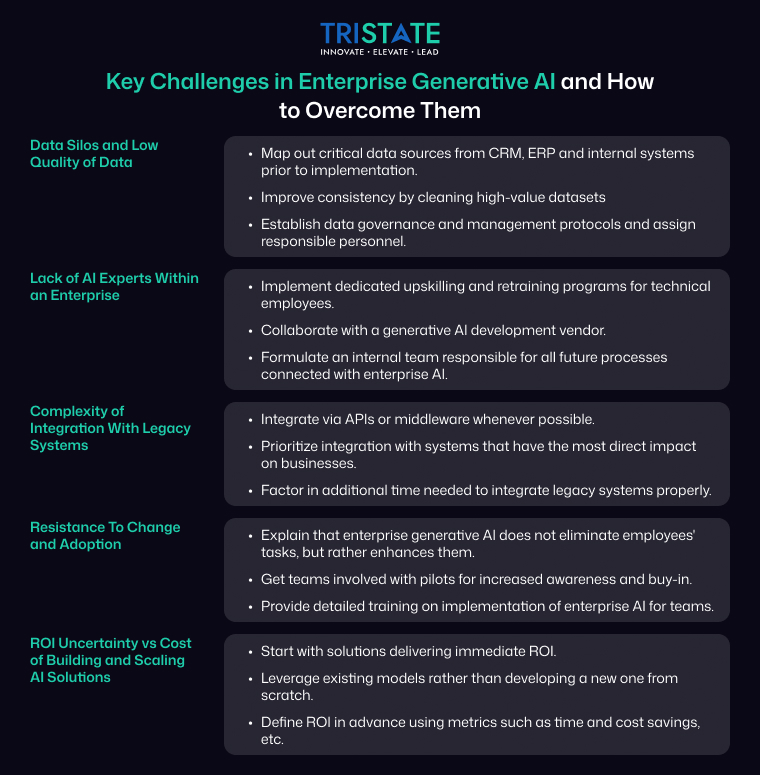
Data Silos and Low Quality of Data
In many companies, data is fragmented among multiple tools, resulting in structural inconsistencies, duplicates, and lack of context that negatively impacts the quality of results produced by enterprise generative AI solutions.
How to solve data silos and low quality data challenge
- Map out critical data sources from CRM, ERP and internal systems prior to implementation.
- Improve consistency by cleaning high-value datasets.
- Establish data governance and management protocols and assign responsible personnel.
Lack of AI Experts Within an Enterprise
Companies cannot implement an enterprise AI solution because the internal staff lacks expertise in designing, deploying, and managing solutions in question.
How to solve lack of AI experts within an enterprise challenge
- Implement dedicated upskilling and retraining programs for technical employees.
- Collaborate with a generative AI development vendor.
- Formulate an internal team responsible for all future processes connected with enterprise AI.
Complexity of Integration With Legacy Systems
Legacy systems weren’t designed to be integrated with modern AI architecture, which results in delayed implementations and limits what can be done in the context of integration.
How to solve complexity of integration with legacy systems challenge
- Integrate via APIs or middleware whenever possible.
- Prioritize integration with systems that have the most direct impact on businesses.
- Factor in additional time needed to integrate legacy systems properly.
Resistance To Change and Adoption
Employees resist implementation of AI due to unclear changes in their job duties. This problem hinders implementation and adoption of enterprise AI in the workplace.
How to solve resistance to change and adoption challenge
- Explain that enterprise generative AI does not eliminate employees’ tasks, but rather enhances them.
- Get teams involved with pilots for increased awareness and buy-in.
- Provide detailed training on implementation of enterprise AI for teams.
ROI Uncertainty vs Cost of Building and Scaling AI Solutions
The cost of building enterprise generative AI is associated with infrastructure, model utilization costs, integration and management. However, ROI in early stages might be unclear.
How to solve ROI uncertainty and cost of building and scaling ai solutions challenge
- Start with solutions delivering immediate ROI.
- Leverage existing models rather than developing a new one from scratch.
- Define ROI in advance using metrics such as time and cost savings, etc.
Enterprise AI deployment faces known challenges that can be solved through strategic planning. Successful implementation of enterprise generative AI requires addressing all constraints before deployment.
Choosing the Right Generative AI Partner for Your Enterprise
Partnerships with vendors should be considered long-term operational decisions rather than technology choices. They determine how your enterprise’s AI strategy is implemented, scaled, and managed. Generative AI products for enterprises require extensive integration and data management practices; therefore, a good generative AI partner is not one who provides technology but the one who fits the way you operate your business.
What to Look for in an Enterprise Generative AI Partner
- A good generative AI partner needs to understand enterprise constraints, limitations, and operational processes, not only the capabilities of the product he/she offers.
- The candidate should have experience in developing enterprise-scale AI applications.
- The partner should show the capacity for working within complex environments and integrating the solution with CRMs, ERPs, and other systems.
- The candidate should have the knowledge of data-related concerns such as compliance, data governance practices and data security.
- A potential partner should know how to convert business problems into concrete examples that will benefit from generative AI.
Key Evaluation Criteria
The process of evaluation ensures that the choice made does not rely merely on superficial abilities. The below-mentioned points are all crucial to long-term success.
- Industry Knowledge & Challenges
Demonstrable experience in your particular field, alongside thorough knowledge of the operational difficulties inherent in your operations.
- Data Security & Compliance
Well-defined procedures to ensure proper handling, security, and auditing of your data throughout the full system lifecycle.
- Integration Readiness
A well-thought-out plan to integrate AI into enterprise systems, especially legacy systems.
- Support & Longevity
Continual support, monitoring, and improvement of the system beyond initial implementation.
Questions to Ask Before Signing a Contract
Before committing, you need clarity on how the partner will handle real-world constraints.
- How will your solution integrate with our existing systems and data sources?
- How do you handle data privacy, access control, and compliance requirements?
- What approach do you follow for scaling from pilot to production?
- How do you measure success and track ROI after deployment?
- What level of ongoing support and optimization do you provide?
Conclusion
This article began with an inquiry into whether generative AI for enterprises should be considered actionable. Now, the answer depends on how you proceed. Generative AI solutions for enterprises are already producing tangible value for organizations that implement them with clarity and confidence, while hesitation continues to increase the distance between those who execute and those who are still evaluating.
The focus now is not on discovering new possibilities but on applying the insight gained here within your organization, identifying where generative AI solutions can accelerate processes, reduce costs, and improve productivity.
TriState Technology works with teams that want to move from ideas to something that actually runs inside their business. Most of the work is not about adding new tools. It is about making sure everything fits into the systems and processes already in place.
If you are considering it, the simplest next step is to have a conversation and see what makes sense for your setup. You can also go through the strategy guide or service pages, but in most cases, things become clearer once you talk it through.
FAQs
-
What is generative AI and how can enterprises use it?
Generative AI for enterprises uses models like Large Language Models to automate tasks, generate content, and analyze internal data within business workflows. Enterprises use it for customer support, document processing, sales enablement, and decision support by connecting AI with existing systems and controlled data environments.
-
How much does enterprise generative AI implementation cost?
Costs vary, but there are some rough patterns. Smaller projects with a clear scope often stay in the $40K to $80K range. Once you start integrating multiple systems or working with more complex data, the cost moves up, often somewhere between $80K and $250K. Larger deployments can go beyond that, especially if there is heavy customization.
-
What is the difference between RAG and fine-tuning for enterprise AI?
RAG works by pulling in the right information at the time of the request, so the response stays tied to your internal data. Fine tuning changes the model itself so it behaves differently for a specific task. In practice, most teams start with RAG because it is quicker to set up and easier to adjust later.
-
How long does it take to implement generative AI in an enterprise?
If the scope is tight and the data is already accessible, you can usually get something working in about 4 to 12 weeks. When more systems are involved or approvals are needed, timelines stretch out. The delays are usually not technical, they come from data access and internal coordination.
-
Is generative AI safe for sensitive enterprise data?
Generative AI can be, but only if the setup is done properly. Running the system in a controlled environment with access restrictions and monitoring is what makes the difference. Without that, the risk increases quickly.
-
What industries benefit most from generative AI in 2026?
Generative AI shows up most in industries that deal with a lot of data and repeated processes. Finance, healthcare, retail, and manufacturing are common examples. The pattern is similar across all of them. Less time spent on routine work and faster turnaround on tasks.
-
How to integrate generative AI into existing enterprise workflows?
Integration usually means connecting the AI to systems that are already in use, like CRM or ERP platforms. The important part is making sure the AI fits into existing workflows. If people have to change how they work too much, adoption becomes a problem.


